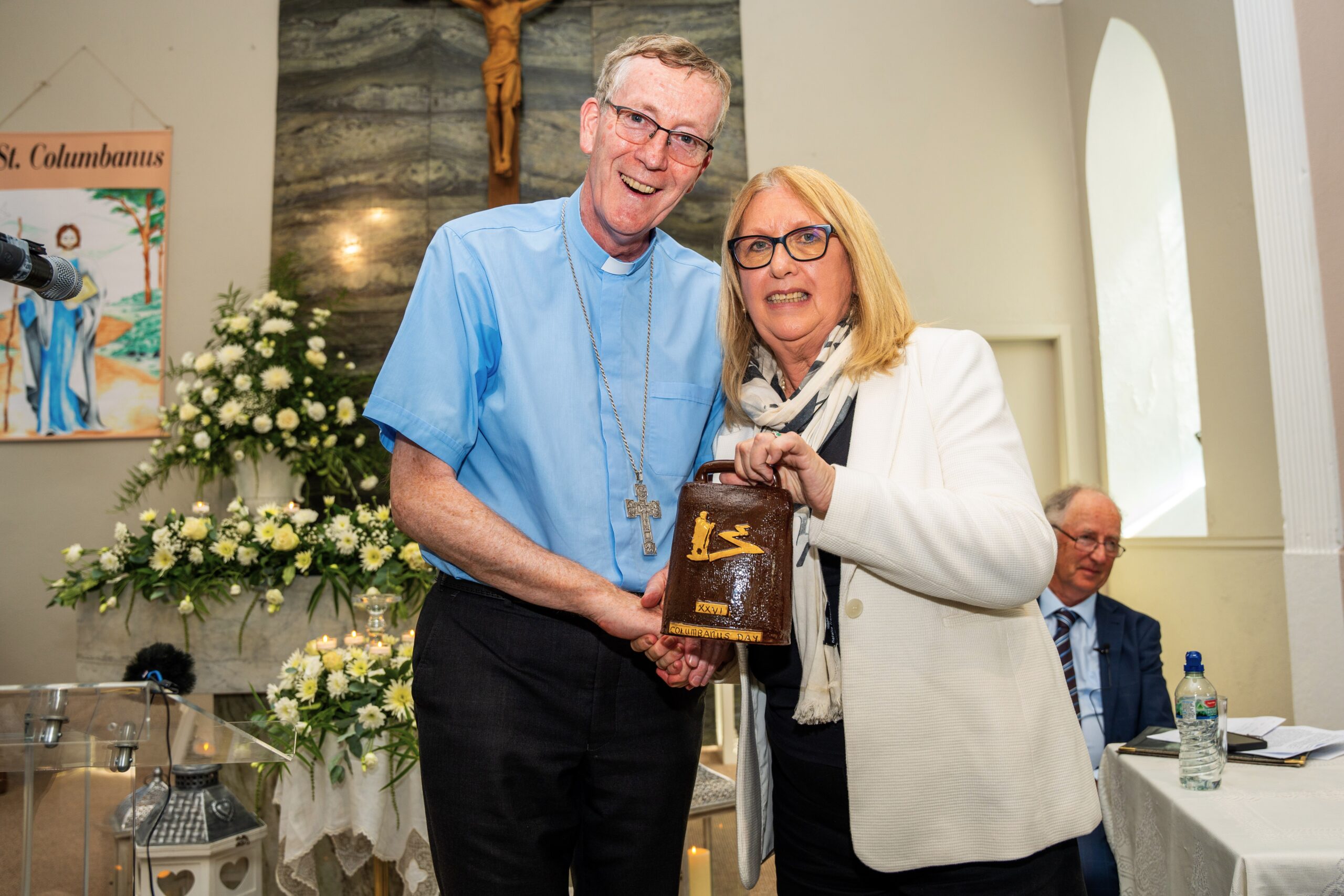
St Columbanus was a man who crossed borders, literally and figuratively, and was the first to speak about a European identity. For his feast day on 23rd November we publish an extract of former president of Ireland Dr Mary McAleese’s talk: ‘Columbanus, the Man from Myshall’ which was delivered as part of the XXV Columbanus Day International Meeting in Carlow.
The beautiful Italian town of Bobbio keeps alive the story of St Columbanus just as passionately as we Irish keep alive the story of St Patrick. It is the story of a stranger who came among them and founded his last monastery and died there on 23rd November 615AD.
St Columbanus’ story endures and we are entitled to wonder why? He and his companions were first and foremost – peregrini pro Christo – pilgrims for Christ. Columbanus’ faith was the driving force that allowed him as a middle-aged monk, already a successful celebrated career behind him, to set out across the seas with twelve companions bound for the madhouse that was Europe, where the new Christian religion was teetering on the brink of vanishing.
He had heard the awful stories from the refugees coming to Ireland. He knew he was in a place of relative safety with no pressure on him to leave. He knew he was heading into serious uncertainty and trouble. Columbanus believed with a ferocious certainty that love of one’s neighbour could change the world, could bring peace out of war and harmony out of discord.
Fortunately, we know a lot about the life of Columbanus because he is the first Irishman to have left a body of his own writing, including poetry, sermons and letters, some of them rather cross letters to the pope of the day. He is also the first Irishman to have been the subject of a biography. His medieval life is in fact well documented including his often argumentative nature but also his great courage and forward thinking.

Artwork depicting St Kolumban in the Church of St Kolumban in Bregenz (Austria). Bregenz is associated with St Columbanus because he founded a monastery there around 611 AD with his companions, though they only stayed for about a year before the outbreak of war forced them to move on to Bobbio. Photo: Sarah Mac Donald.
It was Columbanus (543-615) who was the first to describe Europe as a potentially collaborative union of distinct nations; the first to coin the phrase ‘totius Europae’, the first to persuade the warmongering leaders of a broken Europe, that it was possible to be Irish, Frankish, German, Spanish and also to share a common European identity which would be a shared platform for building a sustainable peace and prosperity through partnership. In a documentary I made several years ago about his life I describe him as the First European. It was not an exaggeration.
Columbanus’ radical vision for a shared Europe of the nations would become the inspiration for the miracle we know today as the European Union. From the still warm ashes of twentieth century wars there emerged in the minds of four Catholic intellectual and political leaders the memory of an idea articulated by the medieval Irish monk Columbanus for a Europe of the nations. They fanned those medieval embers into a flame.
Robert Schumann, Jean Monet, Alcide De Gaspari and Konrad Adenauer became the founding fathers of the European Union, an egalitarian homeland for all, the best and noblest idea anyone in the world has had in millennia except Christ himself. In July 1950 they met in secret in Luxeuil, the site of a monastery founded by Columbanus.
They met on the margins of a conference celebrating the 1400th anniversary of the birth of St Columbanus. Schuman described Columbanus as having “willed and achieved a spiritual union between the principal European countries of his time”, calling him “the patron saint of all those who now seek to build a united Europe”.
Among those present at that secret meeting were members of the Irish government, Winston Churchill and the papal nuncio to France whom we know today as Pope John XXIII. A few years later he would match the historic watershed created by the European Union by convoking the Second Vatican Council and asserting the Church was to become a garden not a mausoleum.
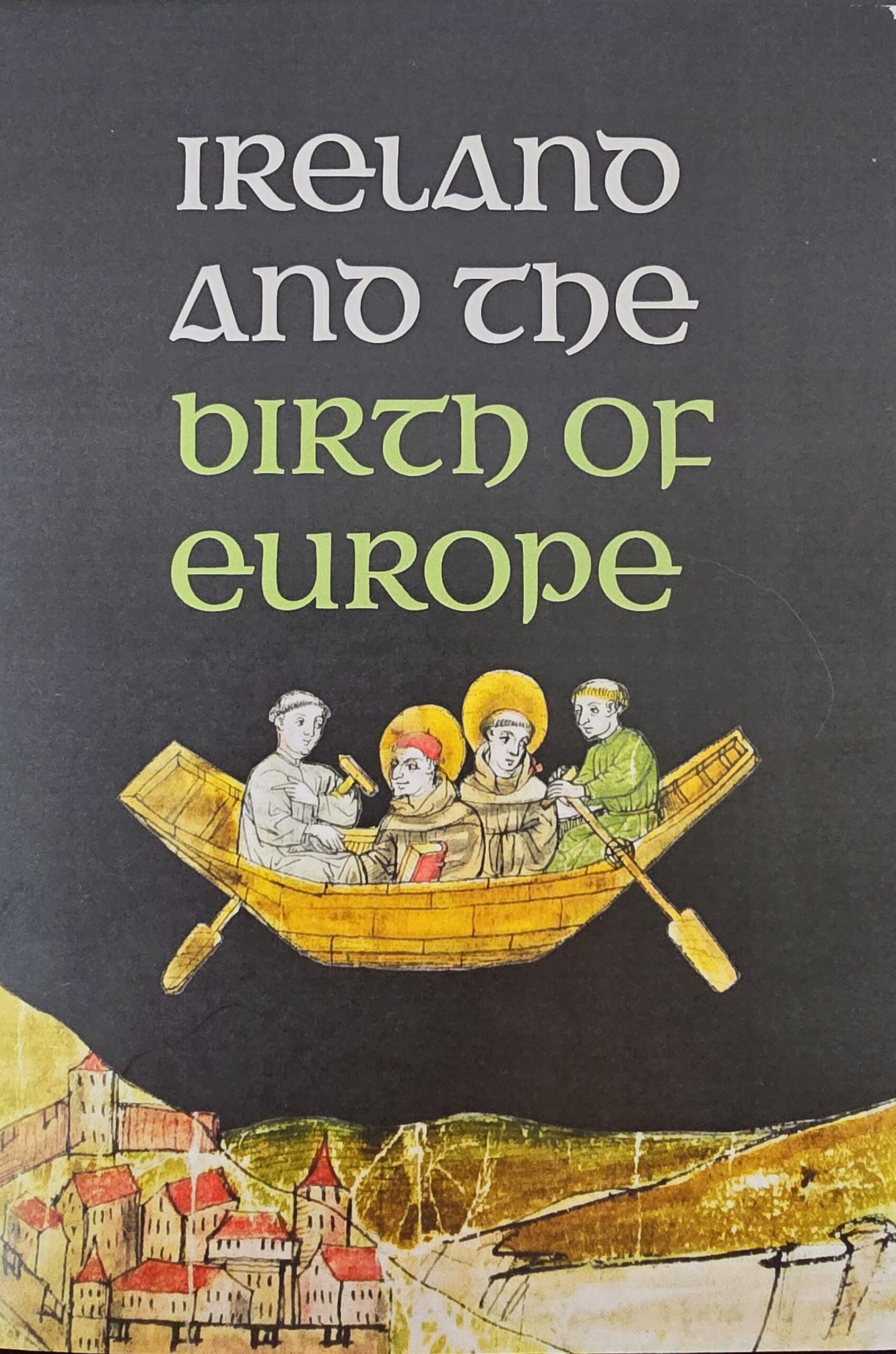
Illustration from the exhibition ‘Ireland and the birth of Europe’ which Professor Dáibhí Ó Cróinín (UCG) launched in Carlow County Museum on 11th July as part of the XXV Columbanus Day International Meeting in Carlow.
In 1963, Pope John XXIII published the greatest papal encyclical so far – Pacem in Terris – on the rights and obligations of people and their states, as well as proper interstate relations. It emphasises human dignity and human equality, endorses women’s rights, immigrant and refugee rights, argues strongly against the arms race and advocates nuclear non-proliferation, support for the United Nations and the Universal Declaration of Human Rights. The imprint of that meeting in Luxeuil is on every page of this encyclical, the imprint of Columbanus is also on every page.
If you doubt Columbanus’ relevance to our times take a look at our world with the existential polycrisis all around as humanity and the earth grow weaker not stronger. He is the author of the Sacred Ordinary, an appeal to religious and secular, to politicians and kings, to find the commonalities which could yet save us from the looming dangers which impact all.
To see Columbanus only in the stones of the monasteries he founded all over Europe is to miss the point. It is his life-enhancing vision of the human person and our earthly home and its flora and fauna that is the real light left by Columbanus.
His words are inscribed on the wall of the Columbanus chapel in St Peter’s Basilica in Rome: ‘si tollis libertatem tollis dignitatem’ – ‘if you take away human freedom you destroy human dignity’.
Those words are to be found too in the first Article of the Charter of Fundamental Rights of the European Union (declared 2000, came into force 2009): “Human dignity is inviolable. It must be respected and protected.” From his grave in Bobbio Columbanus speaks still to a world that needs to hear and heed his voice.
- Anyone who wishes to explore St Columbanus’ life and legacy a bit further:
- Listen: https://www.rte.ie/radio/dramaonone/738530-saint-columbanusthe-first-european
- Read: Rite & Reason: As Pope Leo XIV has reminded us, the Irish missionary’s perspective is as relevant now as it was more than 14 centuries ago. An opinion piece written by Bishop Denis Nulty of Kildare and Leighlin for The Irish Times on Sunday, 13 July 2025. https://www.irishtimes.com/opinion/2025/07/13/as-europe-risks-fracturing-the-message-of-st-columbanus-needs-to-be-heard-again/
- ‘Mary McAleese and the Man Who Saved Europe’, directed by Declan McGrath, is a documentary available on YouTube: https://www.youtube.com/watch?v=DrI0LO13BJc
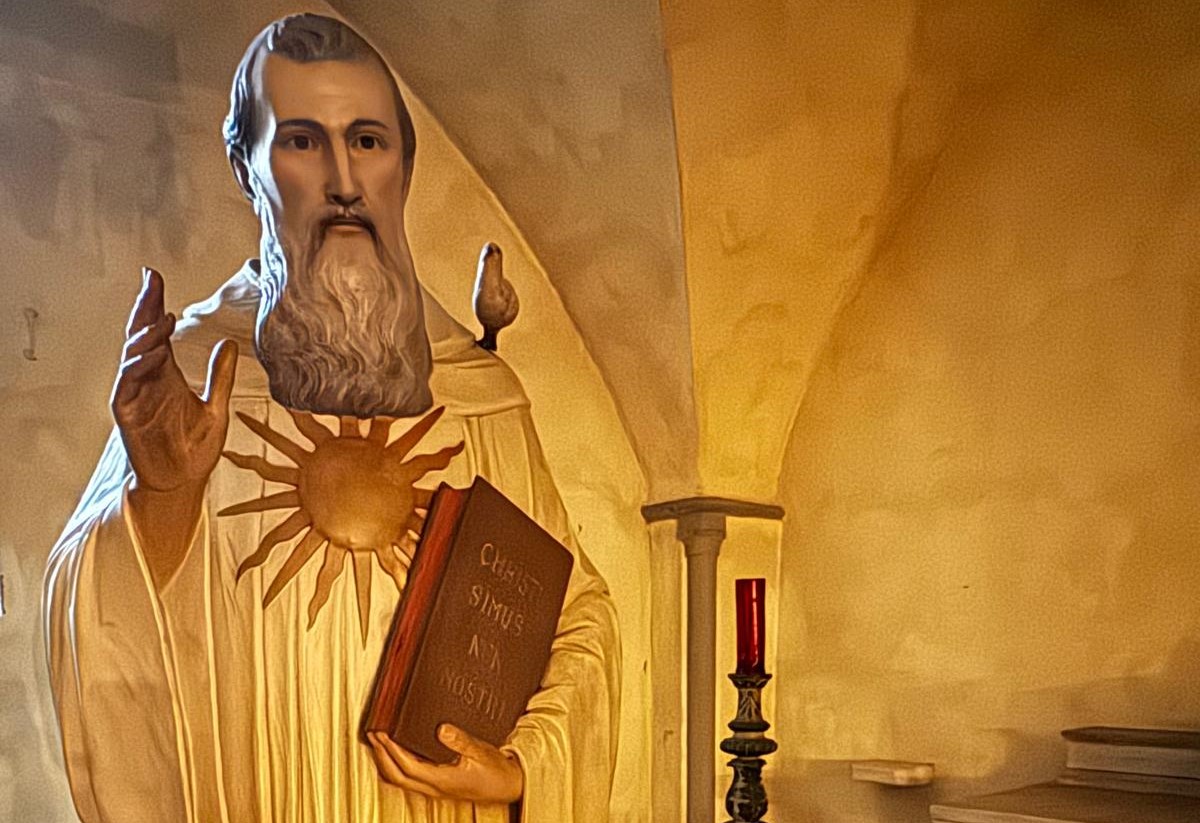
Statue of St Columbanus in the Crypt in Bobbio, Italy, where the Irish monk died in 615AD. Photo: Sarah Mac Donald