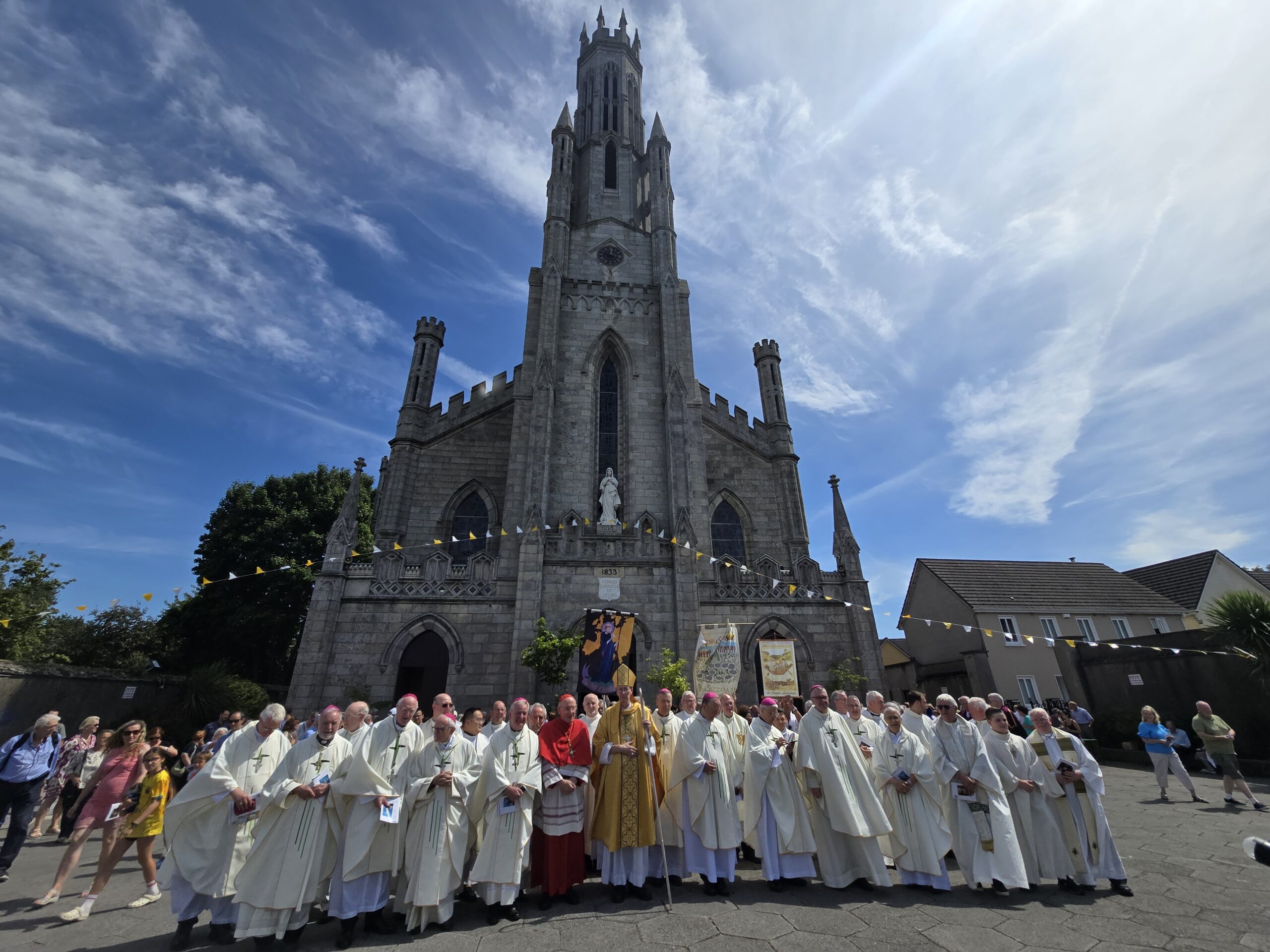
Pope Leo sent his “heartfelt good wishes” to Bishop Denis Nulty and all participants taking part in the XXVI Columbanus Weekend from 11-13th July 2025.
The three-day celebration involved pilgrim walks and talks in Carlow town and the nearby the village of Myshall, in honour of St Columbanus.
In a message from Cardinal Pietro Parolin, Secretary of State on behalf of the Pontiff, Pope Leo said: “In a particular way St Columban, speaking across the centuries, can still teach our world today about how love for God and neighbour requires us to care for creation and to cultivate our souls in the theological virtues, for every aspect of our world reflects in some way the grandeur and goodness of its divine maker.”
“His holiness prays that, by celebrating and reflecting on the witness of this ‘best known Irishman of the early Middle Ages’, who contributed much to nourishing the spiritual life of the Europe of his day (cf. Pope Benedict XVI, Catechesis, 11 June 2008), the present event will bear much fruit for the building up of God’s kingdom in Ireland and beyond.”
In a Reflection following the successful conclusion of the event, which drew pilgrims from Italy, France, Switzerland and Austria as well as from the across the island of Ireland, Bishop Denis Nulty wrote: “As I file away memorabilia from a weekend full of wonderful moments celebrating the great Irish saint, Columbanus, having hailed from the Parish of Myshall traversed Europe founding monasteries and encouraging the idea of the countries of Europe coming together as a collaborative union.”
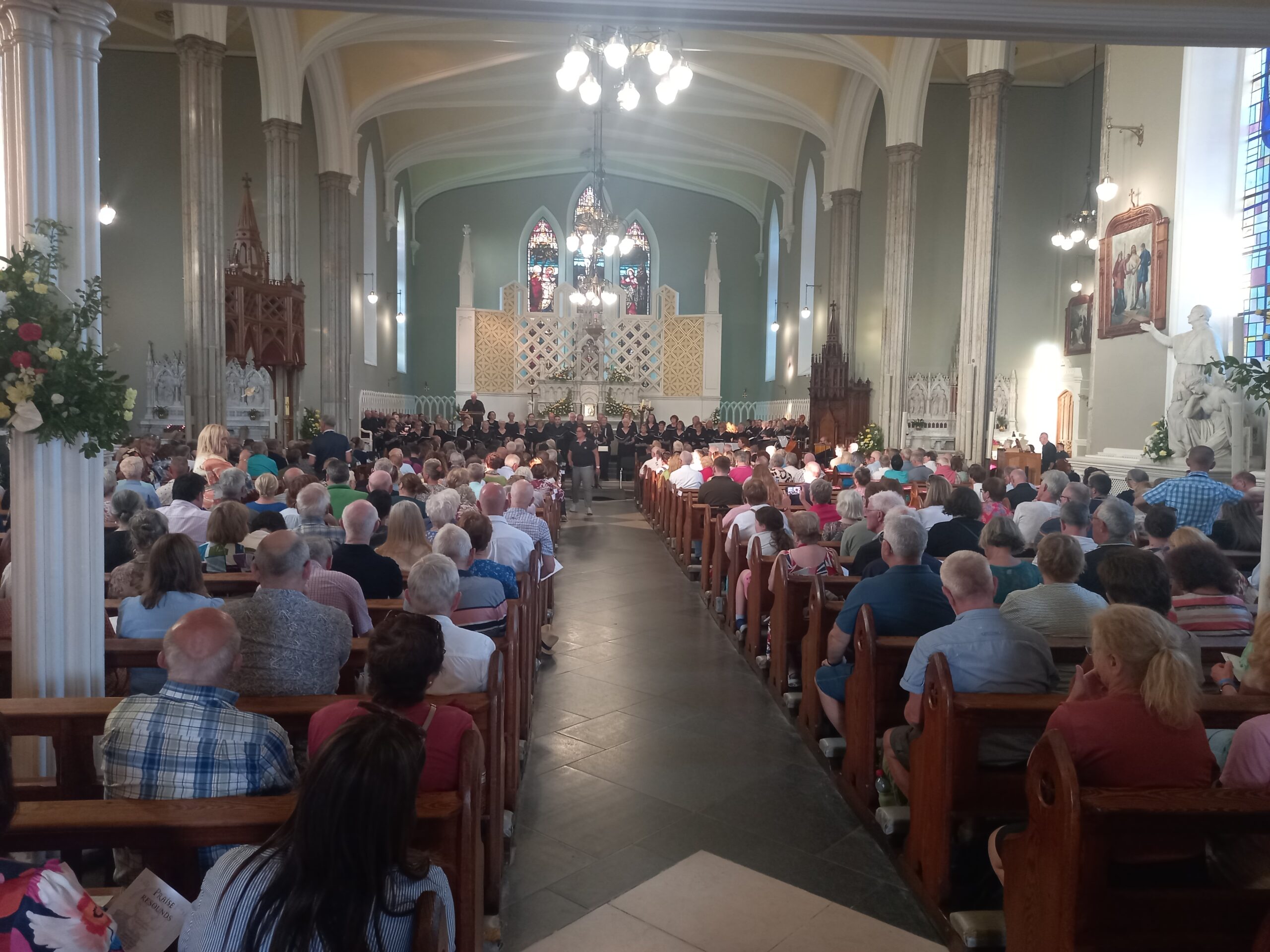
XXVI Columbanus Day Mass in the Cathedral of the Assumption, Carlow. Photo: Fr Pat Colgan
“Columbanus should be embraced today as the saint who can bring us back to the sacredness of creation and humanity. Following the theme for our celebrations, Walking Together in Hope, the weekend had a number of standout and profound moments:
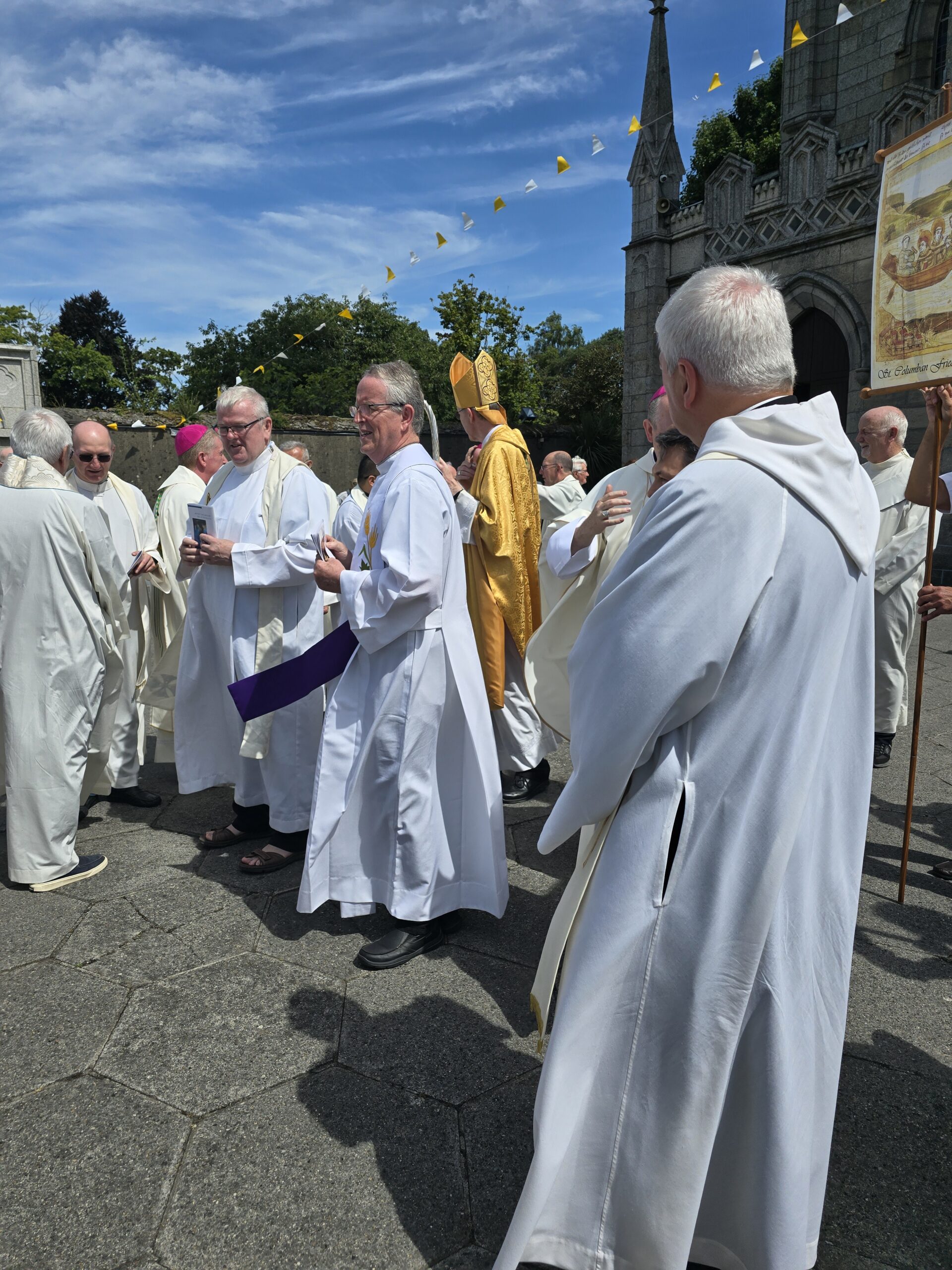
Columban Regional Director, Fr David Kenneally and Vice Regional Director Fr Padraig O’Donovan outside the Cathedral of the Asssumption. Photo: Sarah Mac Donald
- The ‘Ireland and the Birth of Europe’ Exhibition, where we discovered how “Columbanus and his followers contributed to the shaping of a European heritage that endures today”. (Ireland and the Birth of Europe – booklet researched, written and curated by Dr Damian Bracken, University College Cork, and Dr Angela Byrne for the Department of Foreign Affairs).
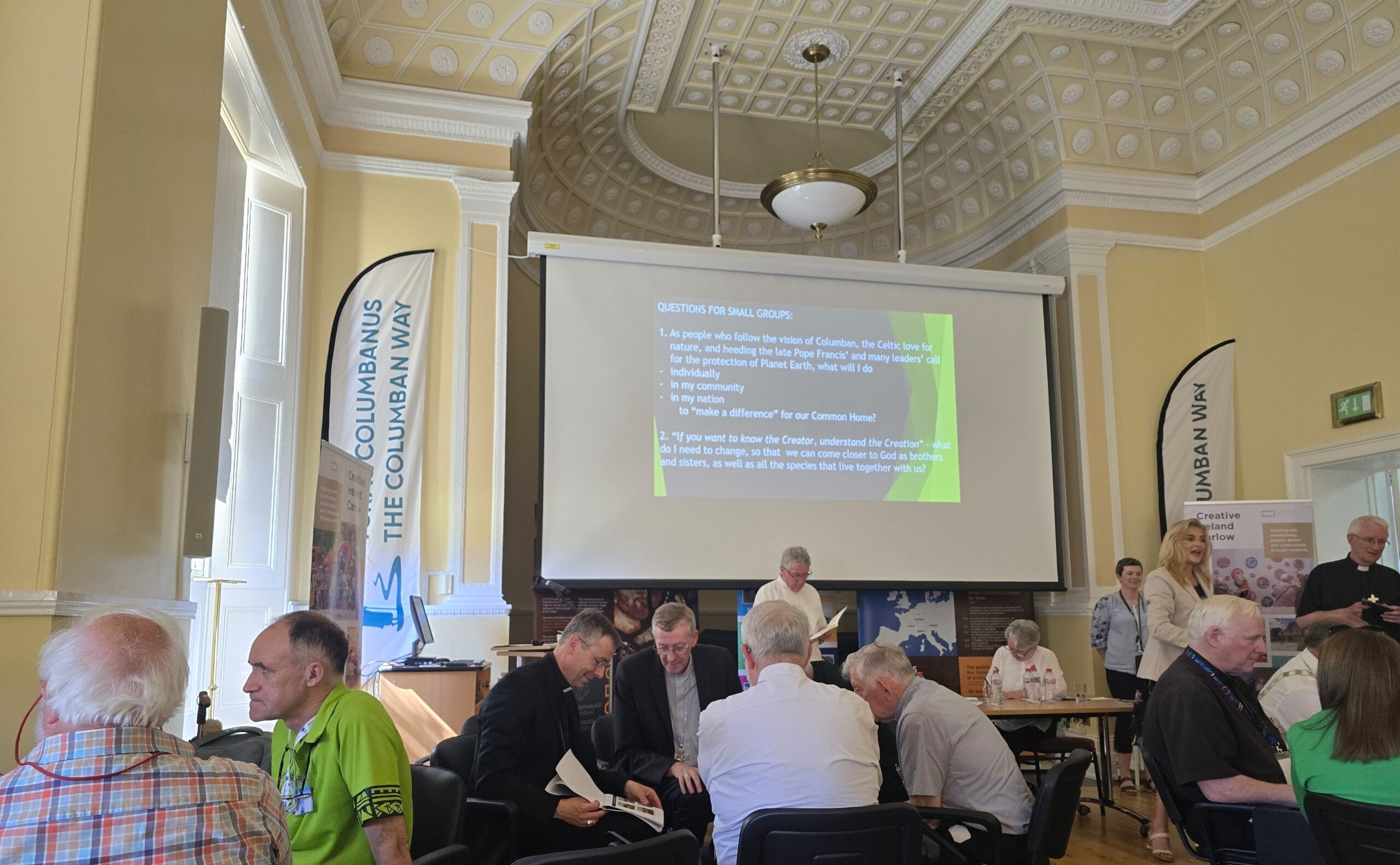
- The Symposium in Carlow College where we heard from Fr Sean McDonagh and Sr Ann Gray how “Columbanus is telling us today that our Christianity must move from an exclusive concern for human salvation and include real concern for the Earth and God’s creation”.
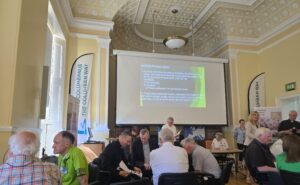
Symposium: ‘If you want to Know the Creator, Understand Creation’ given by Columbans Fr Sean McDonagh and Sr Ann Gray, and facilitated by Cynthia Ní Mhurchú, MEP at Carlow College. Photo: Sarah Mac Donald
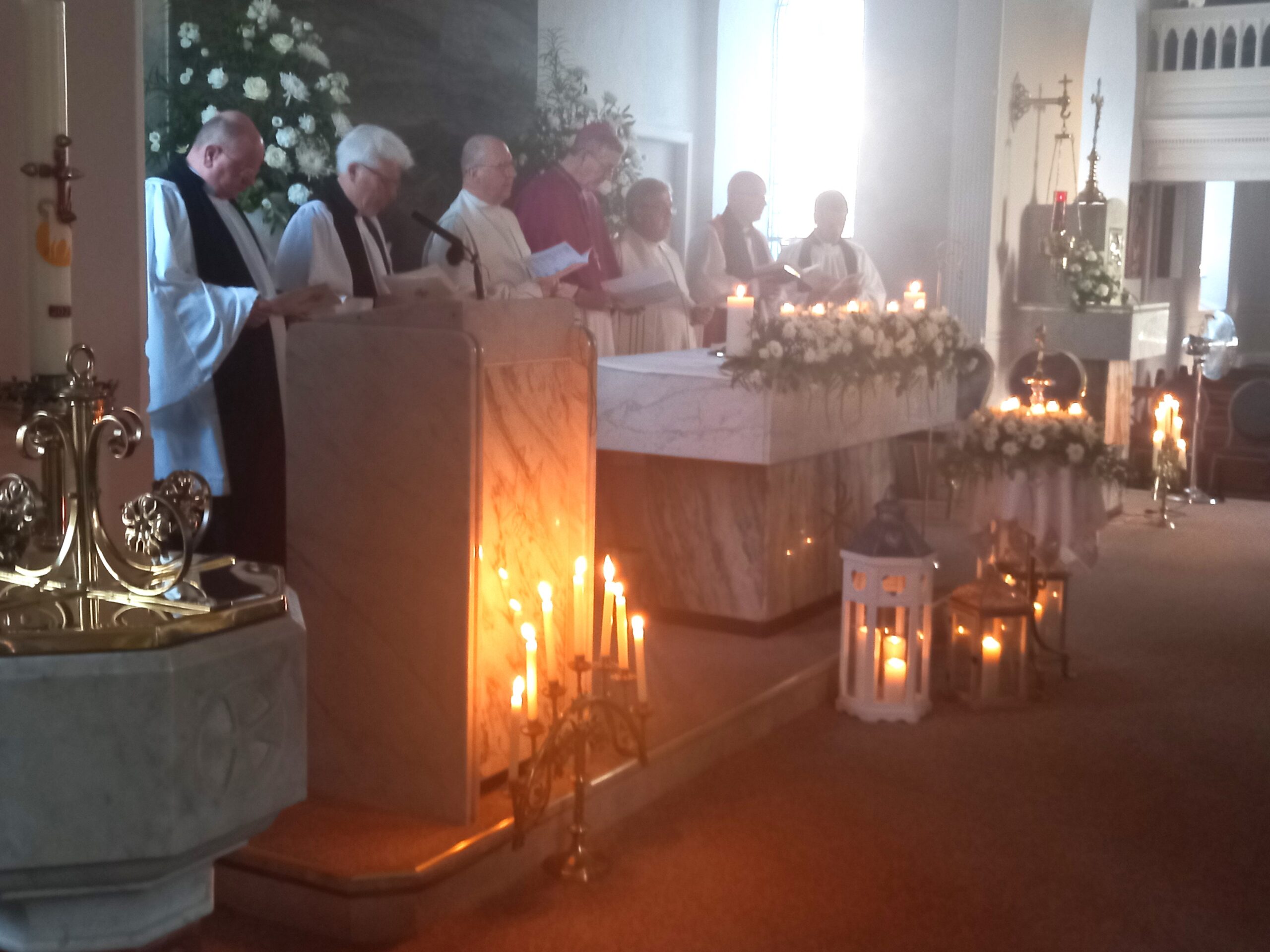
- The Ecumenical Service and procession of the Relics of St Columbanus from the Adelaide Memorial Church of Christ the Redeemer to the Church of the Exaltation of the Holy Cross was our theme, Walking Together in Hope, in action.
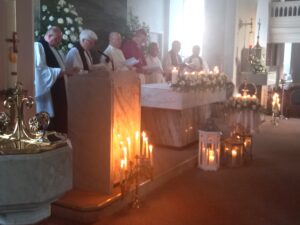
Ecumenical Evening Prayer with procession of Columbanus Relics at Adelaide Memorial Church, Myshall and Church of the Exaltation of the Holy Cross, Myshall. Photo: Fr Pat Colgan
- The walk from the Nine Stones on Mt Leinster, on a section of the Columban Way, finishing in the heart of Myshall Parish where pilgrims shared a well-deserved lunch together.
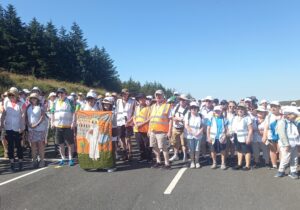
Pilgrims walk from the Nine Stones to Myshall, followed by Buffet Lunch at Myshall Community Hall. Photo: Fr Pat Colgan
- The address by former President Mary McAleese in the Church of the Exaltation of the Holy Cross reminded us of the frailty of our society and how we must embrace one another to really live our faith and be, like Columbanus, “A pilgrim for Christ”. The Man from Myshall received a good cradling, one to be proud of. From his grave in Bobbio, Columbanus speaks still to a world that needs to hear and heed his voice.
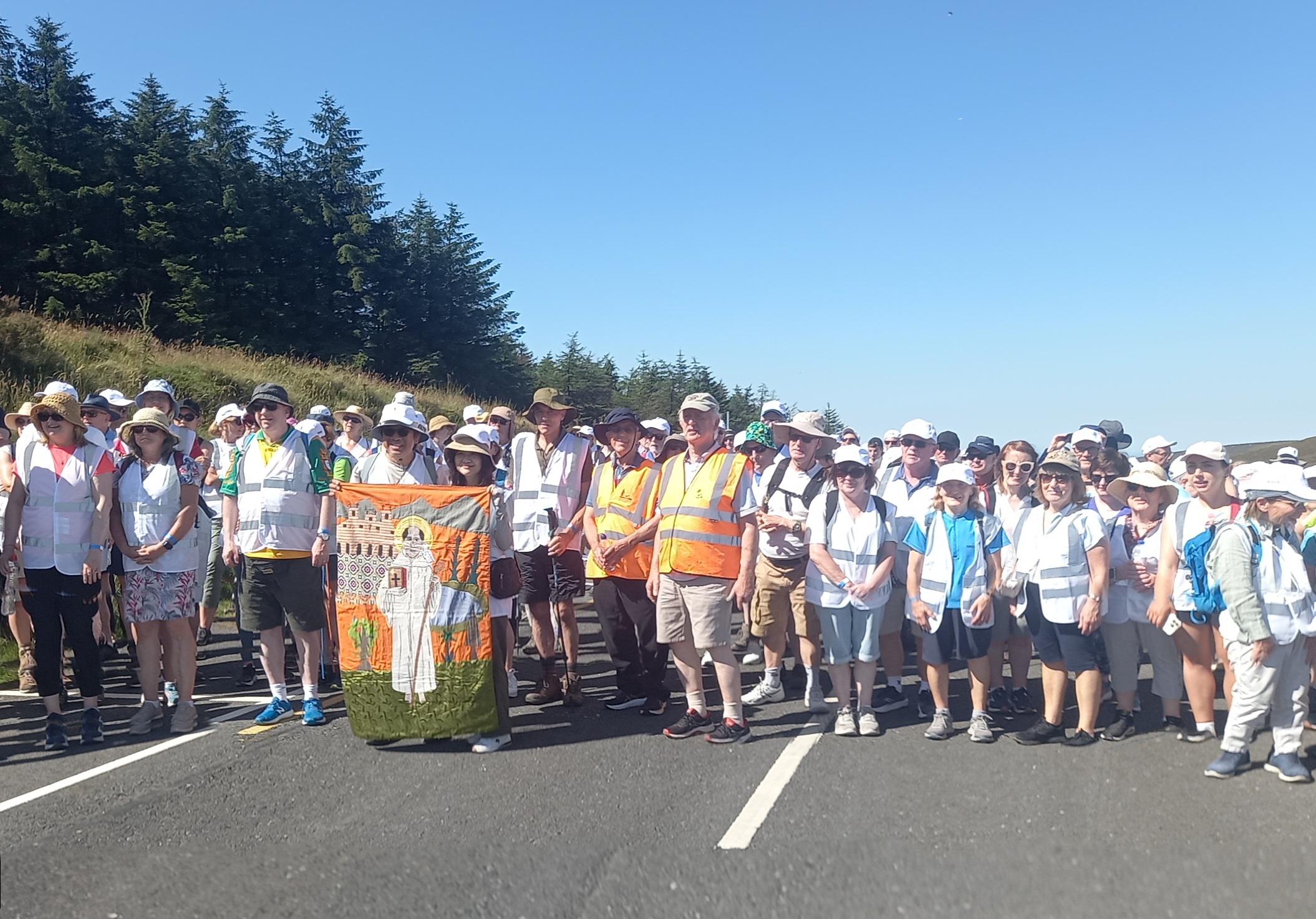
- The most uplifting “Praise Resounds” concert in the Cathedral of the Assumption Carlow where the combination of the various choirs, ensembles and soloists reminded us that through Echoes of the Past there is Hope for the Future.
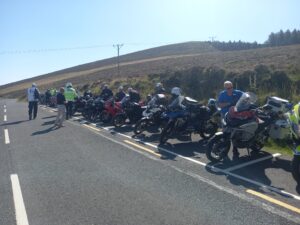

- The celebration of Mass in the Cathedral of the Assumption Carlow where, following the theme for the entire weekend we found ourselves joining together in liturgy through Gaeilge, English, French, Italian and German.
Too many moments that will forever live in my mind and remind me of the shared hope we should all carry with us, as we strive to protect the wonders of creation to safeguard them for future generations and to work together for the good of humanity if we are to live as one, we must hope as one – our shared vision is our shared future.
Columban missionary, Fr Pat Colgan, who was one of the organisers of the international event wrote the following reflection:
“If I do not stop to help [this man], what will happen to him?”
In the parable of the Good Samaritan (Lk 10:25-37), apart from being too ‘busy’ with their religious duties, it is quite possible that both priest and Levite, on seeing the half dead man on the Jericho road, thought to themselves – “What will happen to me if I stop to help him?”, whereas it would seem the Samaritan turned that question completely around to focus on the need of the injured one, not the potential discomfort of the passer by.
At the 25th Meeting of the European Columbanus Associations at Piacenza last July, Bishop Denis Nulty of the Diocese of Kildare and Leighlin issued an invitation to pilgrims there gathered from France, Germany, Switzerland, Italy and Ireland to “Come next year to Myshall”, the birthplace of Columban. There began the meticulous diocesan and county-wide work of planning the XXVI Columbanus Meeting.

The preparatory committee included the heads of Carlow Tourism, Carlow Town and County Councils, hoteliers, the police, parish priests of Carlow and Myshall, Diocesan Education, Civil Defence, Sports Partnerships, Turas Columbanus, the Columban Missionaries, with each meeting chaired by Bishop Denis Nulty himself.
Monthly Zoom and in-person meetings gradually became more frequent and frenetic as July 11th-13th approached. A massive logistical operation swung into operation as banners were erected, roads closed, four-language translations of speeches and homilies prepared, hotel doors swung open, choirs put final rehearsals into liturgies, concerts and impromptu Irish traditional seisúnna popped up in halls and town streets. Carlow even turned on a steady 30C+ continental heat wave for its guests accustomed to such temperatures.
The weekend began with the opening of an exhibition at Carlow Museum on ‘Early Irish Monasticism in Europe” by Prof Dáibhí Iarla Ó Cróinín, followed by a Symposium on ‘Columban and Ecology’ moderated by Fr Sean McDonagh and Sr Ann Gray SSC.
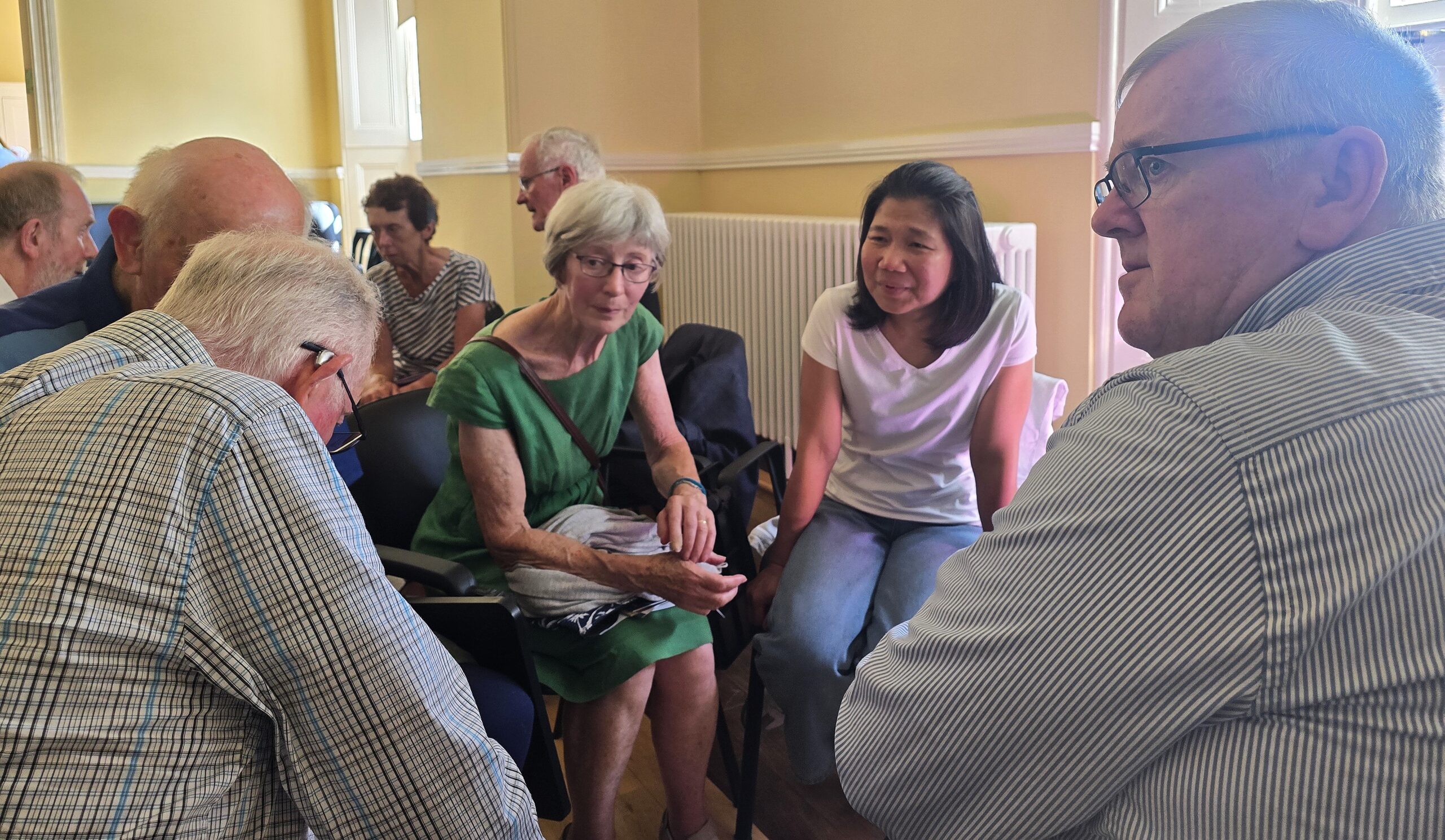
All then moved 22 km up to Myshall for the translation of the relics of St Columban (donated by and brought from Bobbio, Italy) from the Church of Ireland to the Catholic church of the Holy Cross.
Saturday morning began early with pilgrims once again assembled at Myshall for transportation up to Nine Stones (altitude 795m) for the 2.5 hour pilgrim walk back down to the Myshall Community Hall for lunch and then a talk from former president of Ireland Dr Mary McAleese on ‘Columban, the man from Myshall’.
After another civic reception at Carlow College, pilgrims were invited to a gala concert at the adjacent Cathedral of the Assumption with exquisite pieces from the Cathedral Choir, the Praise Ensemble, Choral Society, Schola Cathedralis and soloist Eva Kavanagh. The night concluded with a traditional Irish ‘seisún’ at the Seven Oaks Hotel.
Sunday morning began with a presentation of gifts and appreciation to civic and church dignitaries by Bishop Nulty, after which all moved to the climax of the weekend – Sunday Mass at the Cathedral, at which Bishop Nulty offered a moving reflection on the Gospel of Good Samaritan.
Bishop Nulty linked this challenge to the current humanitarian emergencies in Gaza, Ukraine and elsewhere. He reminded us of the deeply hospitable, and inclusive character of Columban spirituality, in particular his memorable phrase of Sermon 9:
“Let us eat with the poor, drink with the poor, share with the poor that we may deserve to be fed, with them, at the [..] banquet where all are equal…”

Photo: Patrick Bramley
Dr Mary McAleese had spoken of Columban’s habit of speaking uncomfortable truth to the powers of Europe, civil and ecclesiastical, which sowed the seeds for the efforts of many other Irish peacemakers of our time, of whom she signalled John Hume’s tireless efforts for peace in Northern Ireland.
Also Daniel O’Connell’s opposition to violence for political ends, in his championing of the human rights of all oppressed peoples from Russian Jews to African American slaves; Ireland’s militarily neutral but strongly supportive response to Ukraine; Ireland’s calling out of both the evil of Hamas’ anti-semitism and the Gazan genocide of the IDF and its political backers.

Photo: Patrick Bramley
She believes that at its root, in the deepest soul of the Irish, we can find the logic of Columbanus that prompted him to set sail from Bangor in a small open boat and push out into the deep. ‘Love one another as I have loved you. Love your neighbour as yourself.’
Whatever Columbanus learnt in Myshall it was a good cradling, a great cradling, one to be proud of. From his grave in Bobbio Columbanus speaks still to a world that so desperately needs to hear it.
If we do not hear and heed the cry of the many ‘half-dead’ of our world, what indeed will happen to them, and to us?
