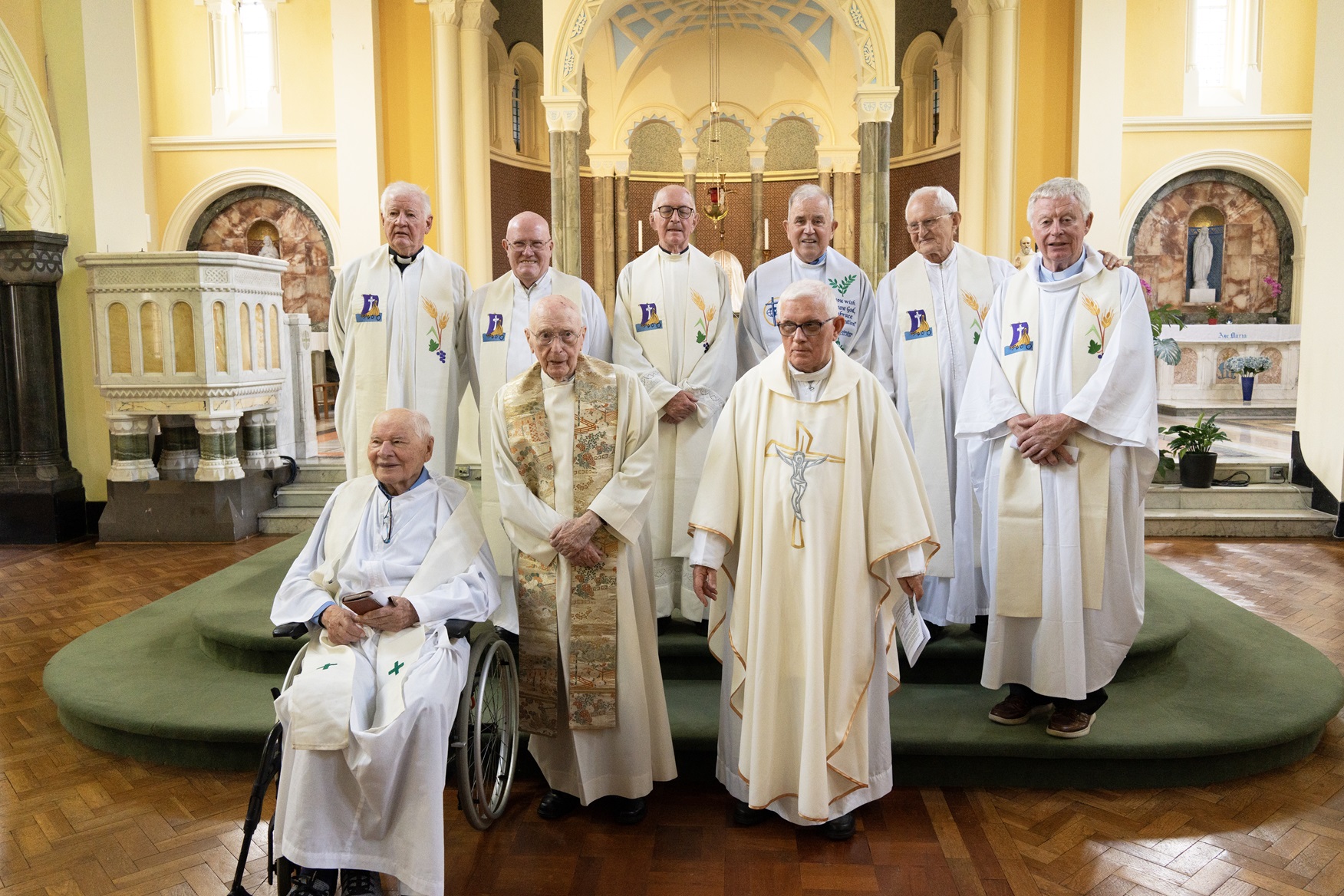
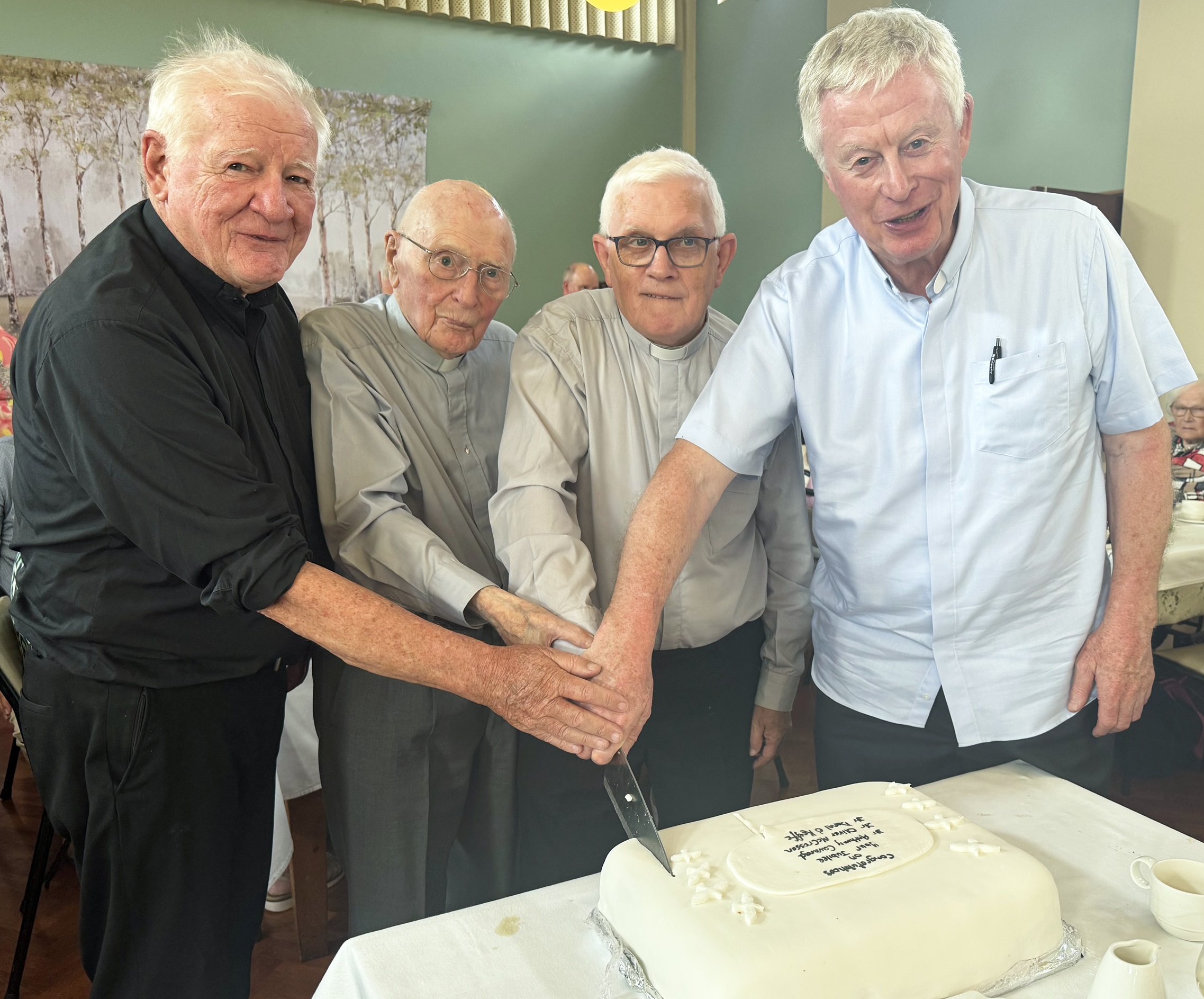
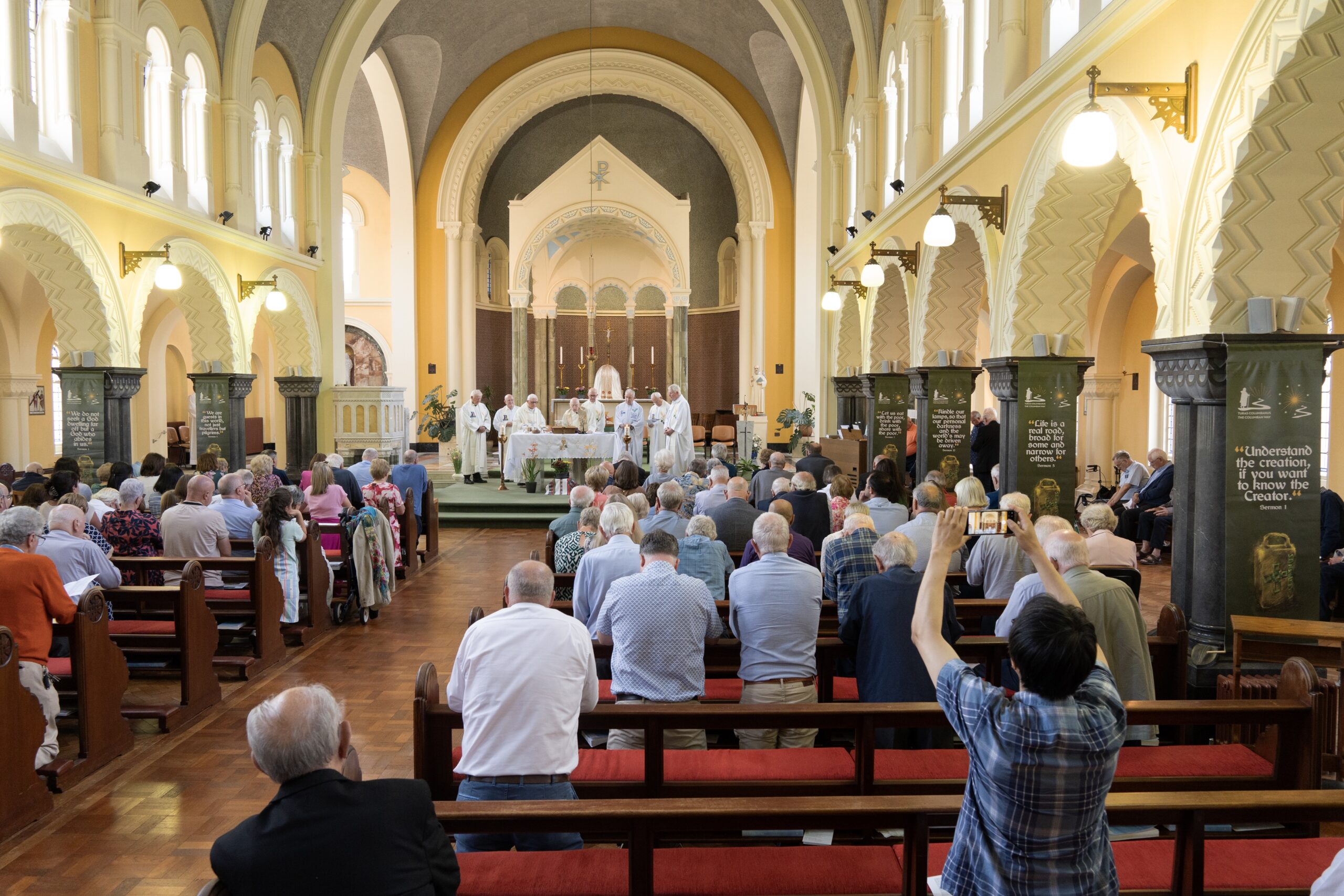
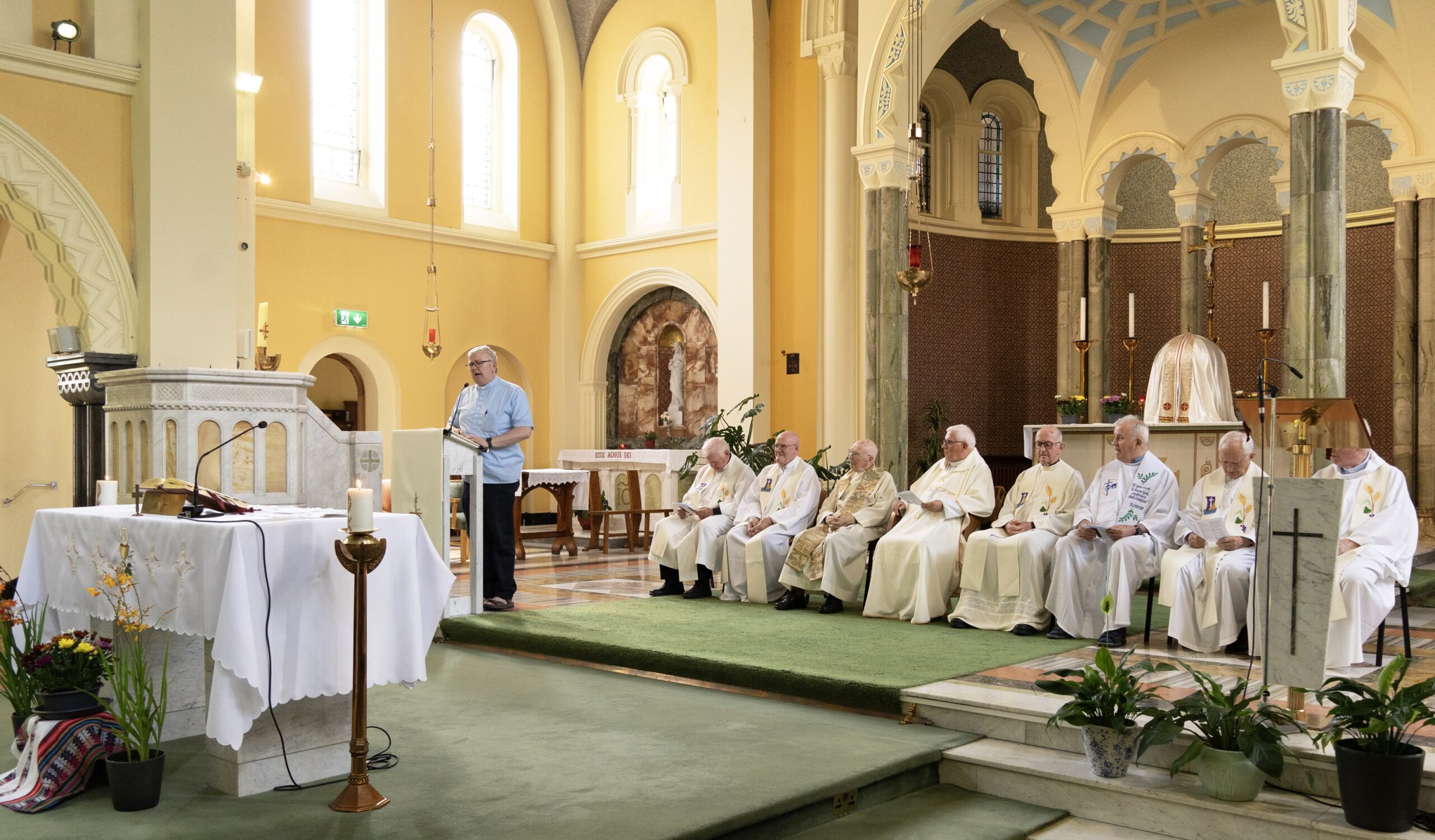
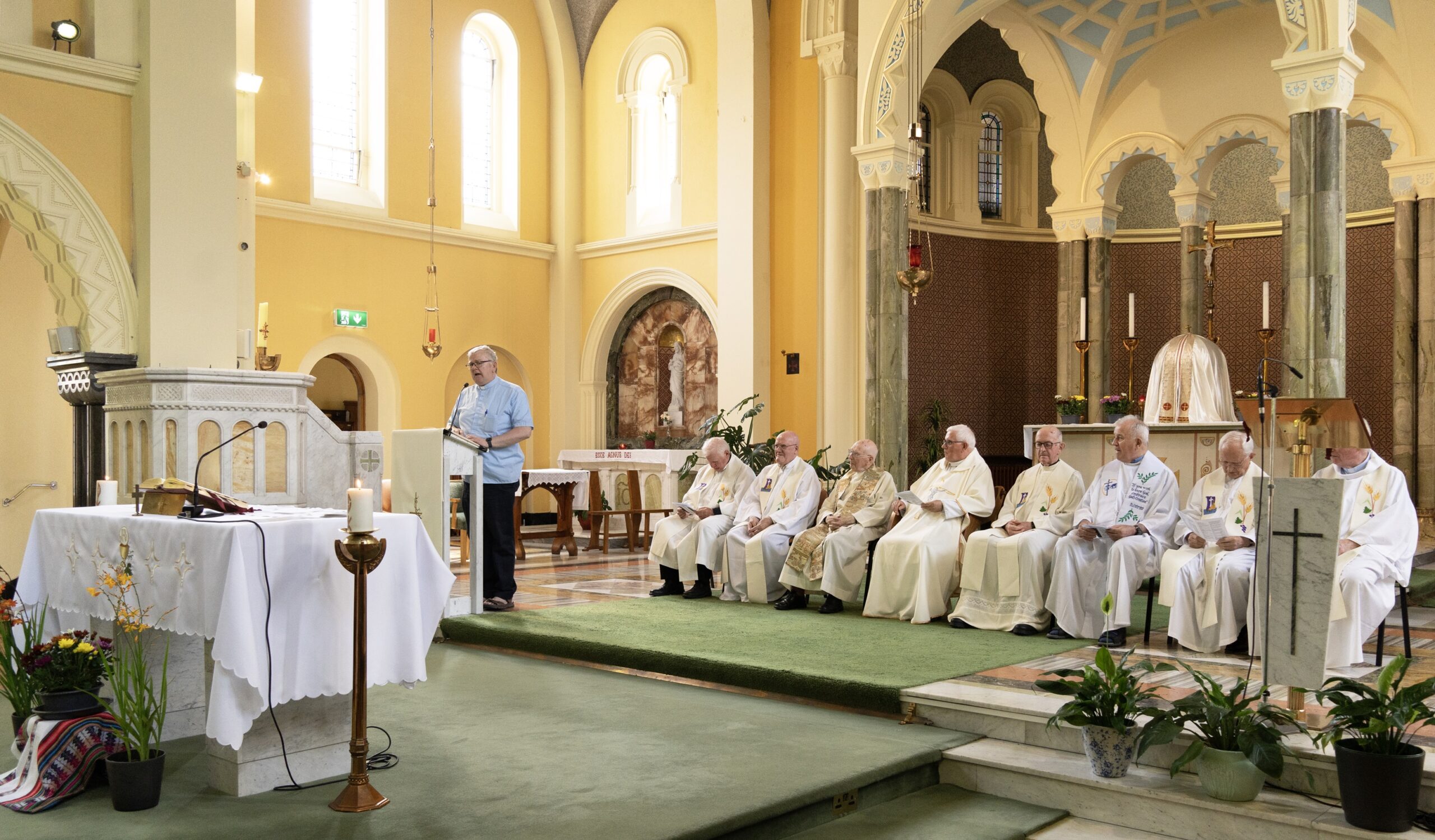
On the 15th August, the Feast of the Assumption, Columban Missionaries gathered in Dalgan to celebrate this year’s jubilees – platinum, diamond, golden and silver jubilees. Fr Seán McNulty was the homilist at the Jubilee Mass in Dalgan Chapel. We reproduce his homily here.
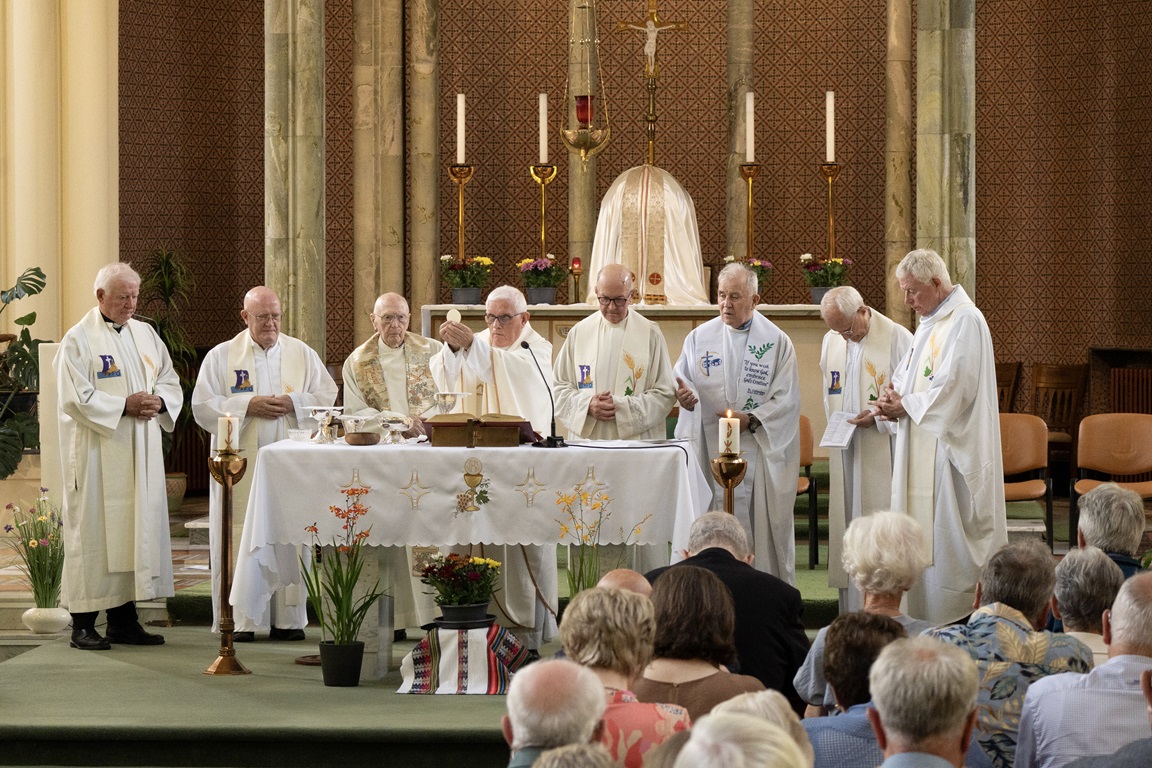
Dear friends, my warmest greetings to you all on this happy occasion. Many of you have travelled far to be here. Your presence is much appreciated. We are celebrating today the platinum, diamond, golden and silver jubilees of Columban missionaries, and you will have noticed that this includes the silver jubilee of two non-ordained Columban missionaries, both from Korea, Son Seon Young and Lee Kyung Ja, who is here today.
KyungJa, 안녕하세요 annyeong haseyo! We are giving thanks for God’s faithfulness to all of us over all these years.
As you have no doubt experienced, God’s faithfulness comes with challenges which may at first dismay you, and with unpredictable consequences which may turn you inside out.
All images: Columban Mission Images
In today’s Gospel, Mary, newly pregnant, begins to appreciate some of the consequences of having agreed to be the handmaid of the Lord. She is challenged to see her situation in a new way and to live accordingly.
Her viewpoint on the world is challenged to radically expand, to go beyond what she would have perceived as her limitations to a more comprehensive view of what God has in mind: life, not just for the Chosen People, but for everybody, justice for the oppressed, food for the hungry, confusion for the powerful. Her “yes” to God, not just once, but all through her life, is what allows these events to be set in motion.
May I draw your attention to two dimensions of the challenge for Mary. The first is what will happen to her personally. This is the minor dimension. The second is what this means for the world. This is the major dimension. I think it is clear that the second dimension, the major dimension of what will happen to the world, depends upon the first dimension, on Mary’s “yes”.
In today’s Gospel reading in the wonderful Magnificat Luke portrays Mary as aware, to some degree, of how her decision is world-changing.
Now I would say that the same dimensions of challenge are true for all of us. We are all personally challenged to become more fully alive, more authentically human, and if it is your vocation, more faithfully followers of Jesus. This is the minor dimension. By taking responsible decisions, as best we can, we are also changing the world, the major dimension.
We know this from our experience in families and in communities, especially communities of faith. The need for responsible decisions is more urgent than it has ever been, because the world is yet again at a crossroads.
The empire of the north Atlantic world and Japan is failing. This is the empire in which contested leadership between rival great powers and competition for resources brought prosperity for some, but for many brought about the death and destruction of wars, ethnic cleansing, genocide, famines, two world wars, the impoverishment of the global south, climate catastrophe and the 89 seconds to midnight threat of nuclear oblivion.
On the positive side there is the rise of the BRICS and other global south groupings such as the ASEAN, SCO, and similar ones elsewhere. It is to be hoped that their rise will be quick enough and strong enough to ensure human survival.
Since the purpose of all religion is to work for the foundational conditions, the values that will enable life for the world, it would appear that religions are more needed than ever despite their historical failings. Our role as a missionary society is to sometimes initiate and in any case to support the positive secular and church and interfaith initiatives that have enabled or contributed to life and hope for many decades.
Church initiatives are now to be found mostly in the global south: in Asia they are led by the Federation of Asian Bishops’ Conferences, the FABC; there are similar Bishops’ conferences in Africa, in Oceania and in Latin America and the Caribbean.
So it is in peril and in hope that today we are celebrating our lifelong commitment to the life of the world and giving thanks that all of us here, have, in various ways, in greater or lesser degree, said “yes” to what we were presented with.
What we are presented with is always gift, but it often takes us, well, takes me quite some time to see it that way, since God’s greatest gifts at first sight so often seem to be disaster, or at least deep trouble, just as they seemed initially to Mary.
For example, all of you have had the challenge of relating to and supporting us who are celebrating our jubilees. We must at times have been and perhaps still are difficult if not impossible to relate to, and so we wish to thank you for not giving up on us.
We know that our decision to become Columban missionaries and generally to spend most of our lives far away from our origins with the nobodies of this world has often done harm to family and community relationships: we have often been absent at life-changing moments such as marriages, births, illnesses, deaths. We are all the more grateful for your acceptance and loving care for us.
We wish to remember those whose challenges are over, members of our families and our friends, the classmates of the Platinum Jubilarians, Malachy Hanratty and Barry Cairns, of us Diamond Jubilarians, and of the Gold and Silver Jubilarians.
Today we remember and celebrate also with our colleagues and classmates whose challenges led to their taking a different path, and wish to thank them and their wives/widows for their continuing solidarity and friendship. I would like to acknowledge and welcome the presence of Stasia Crickley O’Connell, and of Mick and Caroline Gavin. We have learnt that no two persons’ vocations are exactly the same; there are many mansions in our Father’s house.
I wish to remember too, with gratitude, the Missionary Society of St Columban. Despite its many faults and faultlines it has been our community of faith, our “band of brothers” that has enabled our lives and work to unfold in the service of people in other lands.
Our founders, Bishop Ned Galvin and Fr John Blowick wished that it would be bonds of charity and friendship, what was known in Ireland as the “Dalgan spirit,” that would hold us together. Throughout the over one hundred years of the life of our Society of St Columban, this spirit has been continuously challenged to take new forms as the world changed and our situation changed.
The challenges have become ever more comprehensive and foundational, as, for example, our particular tasks, organizational culture, formation processes, structures and identity all demand change in responding to the constant but ever-fresh love of God. You can get some hint of how our Society is responding by the composition of our leadership group.
Our Society leader is Andrei Paz who is Filipino; his vicar is Australian, his second and third councillors are Korean and Peruvian respectively.
And finally a major factor to give thanks for has been the people of the many nationalities and cultures among whom we have worked. Their faith, including the faith of the unchurched, has evangelized us; it has challenged and deepened our faith. Their sufferings under the multiple modern oppressions and established disorders point the way to everybody’s liberation.
Their struggles against the false gods of power, wealth and prestige have revealed to us the true face of God. Their wonderful humanity has healed us, has helped make us whole. Their languages and cultures have given us a deep appreciation of the wonderful diversity, along with the complexity, of the human condition. Their languages and cultures have given us new ways of seeing, new ways of seeing through the eyes of the victims.
It has been a blessing and a privilege to work with them. They have taught us, as the fox taught the Little Prince, but for us through the nuances of many languages, that it is only with the heart that one can see rightly, that what is essential is invisible to the eye. As the Chinese put it: 天下一家 Tiānxià yījiā. (We are all) one family under heaven.
Footnotes:
- In this 21st century it has abandoned the treaties meant to prevent nuclear first strike so that the doomsday clock stands at 89 seconds to midnight. In January of this year the Bulletin of Atomic Scientists says: “Blindly continuing on the current path is a form of madness.”
- Our poetic naming of some of the consequences for Mary personally as “Assumption” conveys no more than a hint, a whisper, an obscure glimpse of what it all means and where it is going. We can see that it is somehow consistent with and a kind of anticipation for Mary of the “resurrection of the body” we affirm in the Apostles’ Creed.
Since this is where it is all going for the human race, the Assumption is almost as much about all of us as about Mary. It is something about affirming the value and beauty and some kind of continuity of our bodiliness, of our materiality. It may be that the only way we can say anything about it is in poetic language. The point is that as for Mary, so also for us.
And if all of us are affirmed that Mary’s present situation will eventually be ours too, more or less, we are all challenged, as she was, to say “yes” to life and to then brace ourselves for what will happen next. As we go through life and get older you and I all know from our experiences that challenges don’t become less or fewer, they just become different.