Columban priorities adopted at the General Assembly in Peru in 2024 were at the heart of a key address by Cardinal Jean-Marc Aveline of Marseille to the Congress of the European Society for Catholic Theology at Trinity College Dublin in August, organised by the Loyola Institute.
The four-day Congress explored the relevance of theology for contemporary Europe and today’s many challenges.
In his address on the theme, ‘Toward a Theology of Mission’, Cardinal Aveline drew on his experience of working in the area of interreligious dialogue.
“I perceived that among Christians there is often an opposition between those who support dialogue, and those who privilege mission. One group is suspicious of relativism, the other of proselytizing. But a deepening theology allows one to surpass this sterile opposition.”
Cardinal Aveline recalled how he had been deeply moved by a meeting with two of the monks who survived the Tibhirine abbey massacre in Algeria in 1996, and their belief that the essence of missionary activity lay in the creation and nurturing of “neighbourly relations”. He said this evangelical proximity has never been more important.
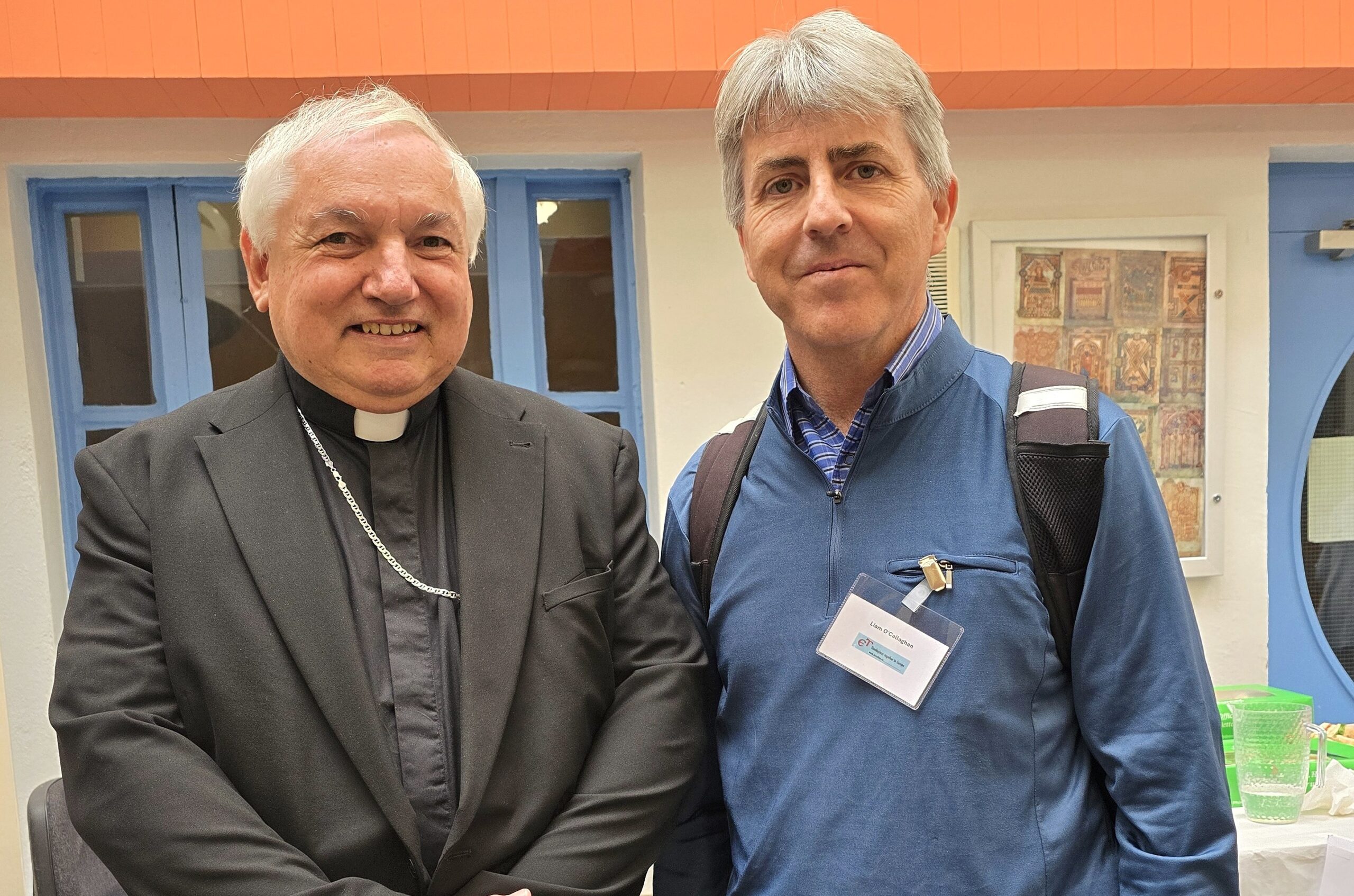
After his talk, Cardinal Aveline met Columban Missionary Fr Liam O’Callaghan who works in Pakistan in the areas of interfaith dialogue and care for the earth.
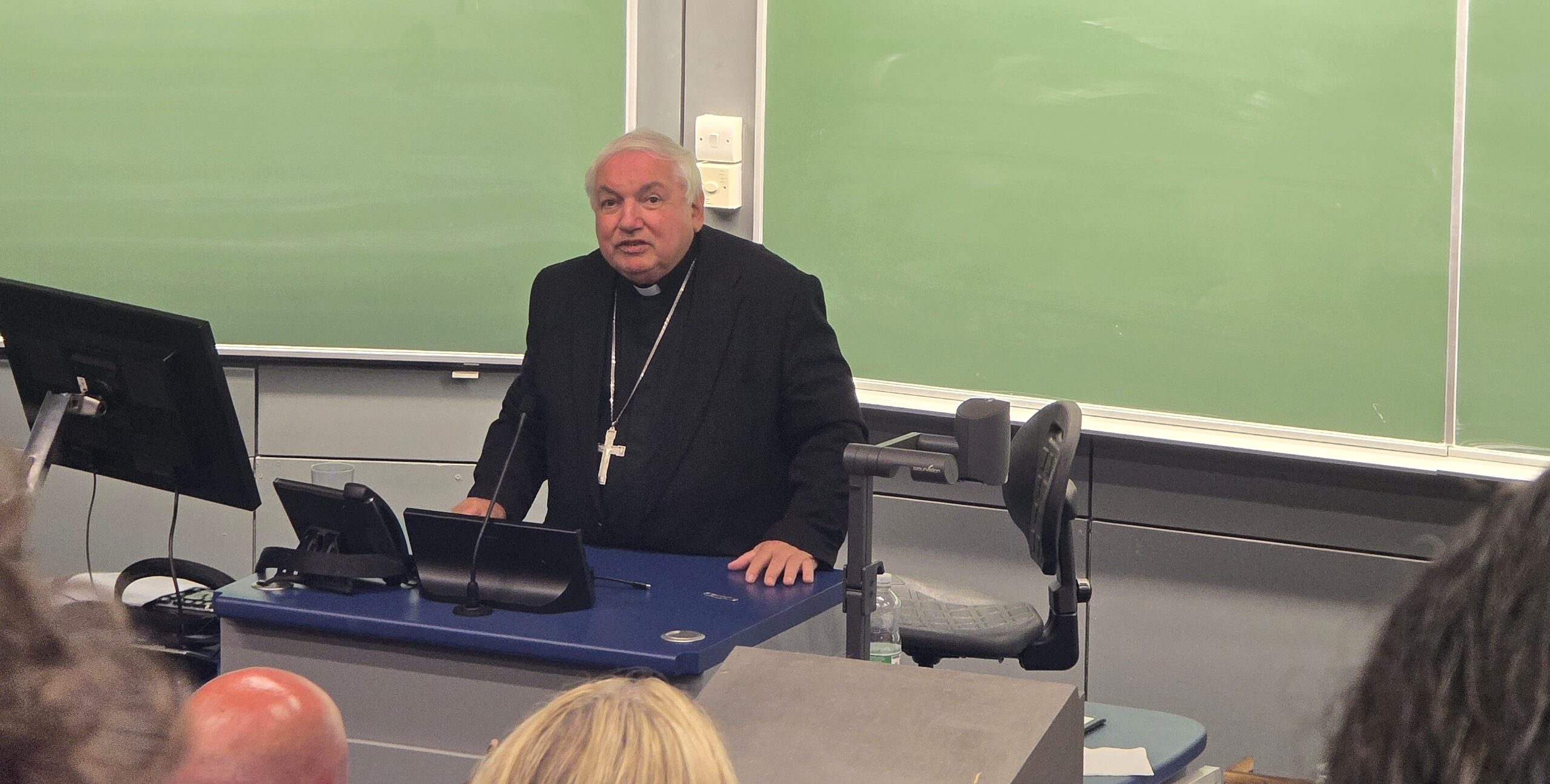
Cardinal Jean-Marc Aveline delivering his lecture ‘Toward a Theology of Mission’ at TCD. Photo: Sarah Mac Donald.
Columban Priorities identified at the Assembly include Dialogue and Inculturation: promoting authentic dialogue with other religions and cultures to spread the Gospel. Other priorities are Justice and Peace and Environmental Concerns.
A central concern for the Columbans is challenging structural poverty and the violence associated with it and caring for the Earth is integral to all issues of justice and peace, making it a core part of their missionary work.
In his recent address in Dublin, the Cardinal Archbishop of Marseille argued that mission should free the Church from a preoccupation with its own survival, opening it to the unknowable breadth and depth of God’s work.
Marseille breathes with two lungs, he said, one European, the other Mediterranean. It is a very cosmopolitan city, and the experience of religious plurality and the consideration of the legitimacy of each religion’s claims to truth lies behind these reflections on the challenge of being a missionary Church in the contemporary world.
“I remember a meeting a few years ago in Meknes, to which the Archbishop of Rabat had invited me. Monks from the Monastery of Notre-Dame de l’Atlas in Midelt were present, including the two monks who survived the Tibhirine abbey massacre in Algeria in 1996, Amédée Noto and Jean-Pierre Schumacher.”
“They explained to us that, for them, the essence of missionary activity lay in the creation and nurturing of “neighbourly relations”. This was marked by attentive closeness to individuals and to families, lived out with simplicity and fidelity, for the sake of Christ Jesus, whose disciples they openly acknowledged themselves to be.”

Cardinal Jean-Marc Aveline, Archbishop of Marseilles, Congress co-ordinator Dr Fáinche Ryan and Archbishop Eamon Martin, Archbishop of Armagh, Primate of All Ireland. Photo: Loyola Institute.
“The two monks have both since died. Their testimony, already sealed by the blood of their brothers, made a deep impression on me. This ‘evangelical proximity’ should be the first sign of Christians in their way of being in the world, especially in a time of what Pope Francis regularly denounced as the ‘globalisation of indifference’.”
From his very first encyclical, Ecclesiam suam (1964), Pope Paul VI set out the fundamentally dialogical dimension of revelation and therefore of mission: “Revelation, which is the supernatural relationship that God Himself took the initiative to establish with humanity, can be represented as a dialogue (colloquium) in which the Word of God is expressed through the Incarnation and then through the Gospel … The history of salvation precisely recounts this long and varied dialogue which comes from God and engages humanity in a manifold and astonishing conversation.”
“We cannot put dialogue and mission in opposition to each other. Rather, the point is to live the command of mission in the spiritual attitude of dialogue. Dialogue is more than a mere condition for making proclamation of the Gospel possible.”
“The very proposition of dialogue is already an implicit announcement of the Good News of the Triune God. It is often because our theology is not sufficiently Trinitarian that our missionary activity lacks its dialogical dimension. The Church quickly runs out of breath when it pretends to breathe in place of the Spirit.”