During my time in Korea, I cared for patients suffering from Hansen’s disease, more commonly known as leprosy, a word we rarely use nowadays due to the stigma attached to it. I worked in a small 30-bed hospital with an Outpatient Skin Clinic.
The doctor interviewing me highlighted that it was an infectious disease, but also stressed that if I was to be of any help to the patients, I would first have to overcome my fear of getting the disease.
Every week our mobile clinic visited a different health centre in the province, to review our patients and supply them with their monthly medicines, after which we called to the leprosy villages nearby, taking back with us those in need of hospital care.
Fear of catching the disease meant that these communities were isolated, and those with visible signs, such as deformities and missing eyebrows, experienced much rejection from the wider community, which added greatly to their anguish and distress.
Some coped by rejecting all outsiders, with a ‘them and us’ world view where anyone who was not ‘one of us’ was excluded; while others, through their own struggles and difficulties, identified with those facing rejection for different reasons, and embraced their sufferings as their own. In addition to these, there was a whole variety of ways of responding to the deep negativity that goes with feelings of rejection.
‘John’ is a man whose hidden life was a source of inspiration for mine as I express here:
He sat there in the sunlight staring into space,
his unseeing eyes steady, in their fixed gaze.
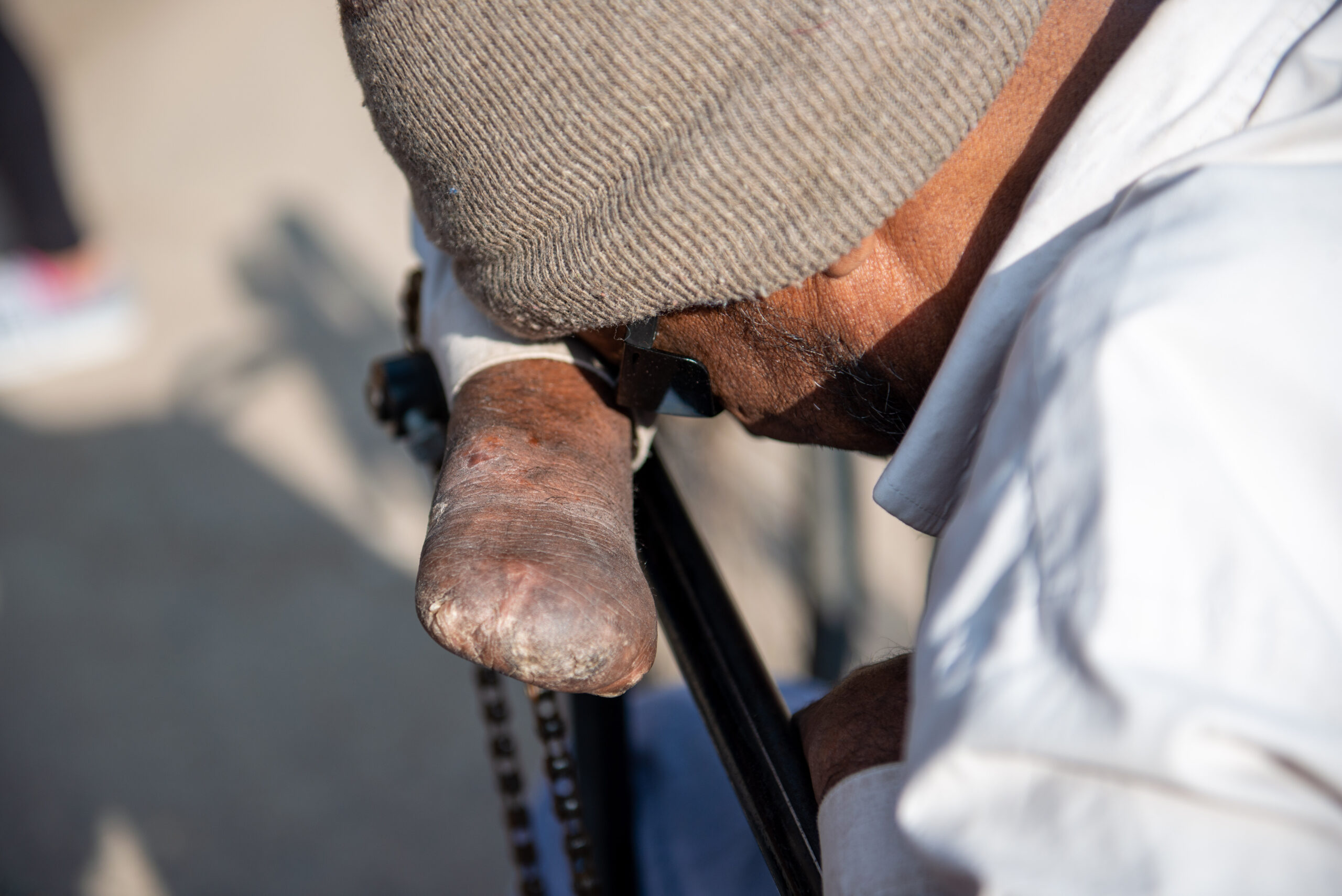
I looked at his stumps of hands and down at his mangled feet,
and marvelled at his composure, and obvious inner peace.
Gently I addressed him, calling him by name,
‘John, I have your medicine’, and he smiled up at my face.
But before I could bend down to him, his body moved in prayer
as with his crippled hand he blessed himself as a child does, with care.
If ever a man had cause to curse surely, it was he.
But John took life as a blessing and so in his heart was free.
Blind, his vision was clearer than many a sighted soul,
And the radiance of God’s life in him, only a few have had the joy to behold.
That night I went to the chapel and knelt before my Crucified Lord,~
But His was no strange presence for in His features, John, I saw.
Today, we hear very little about Hansen’s disease (leprosy) except in Bible stories. It has been replaced by other fears, HIV/AIDS, SARS, COVID, drug and alcohol addiction, immigrants, and those whose views differ strongly from our own. What better time than the beginning of a New Year, to have the courage to face and name our own personal fears and not allow them to lead us to reject or belittle others who are different from us in health, colour, race, gender, politics or religion.
Jesus reminds us, ‘Treat others as you would like them to treat you.’ (Luke 6:31) What a friendlier and peaceful world it would be, if respect and tolerance shaped our relationships with each other and between nations.
Sr Roberta Ryan
World Leprosy Day takes place on Sunday 25th January 2026.

First published in the January/February 2026 issue of the Far East magazine. Please subscribe to the Far East and support Columban Missionaries in their work with the most disadvantaged. See https://columbans.ie/far-east-magazine/