
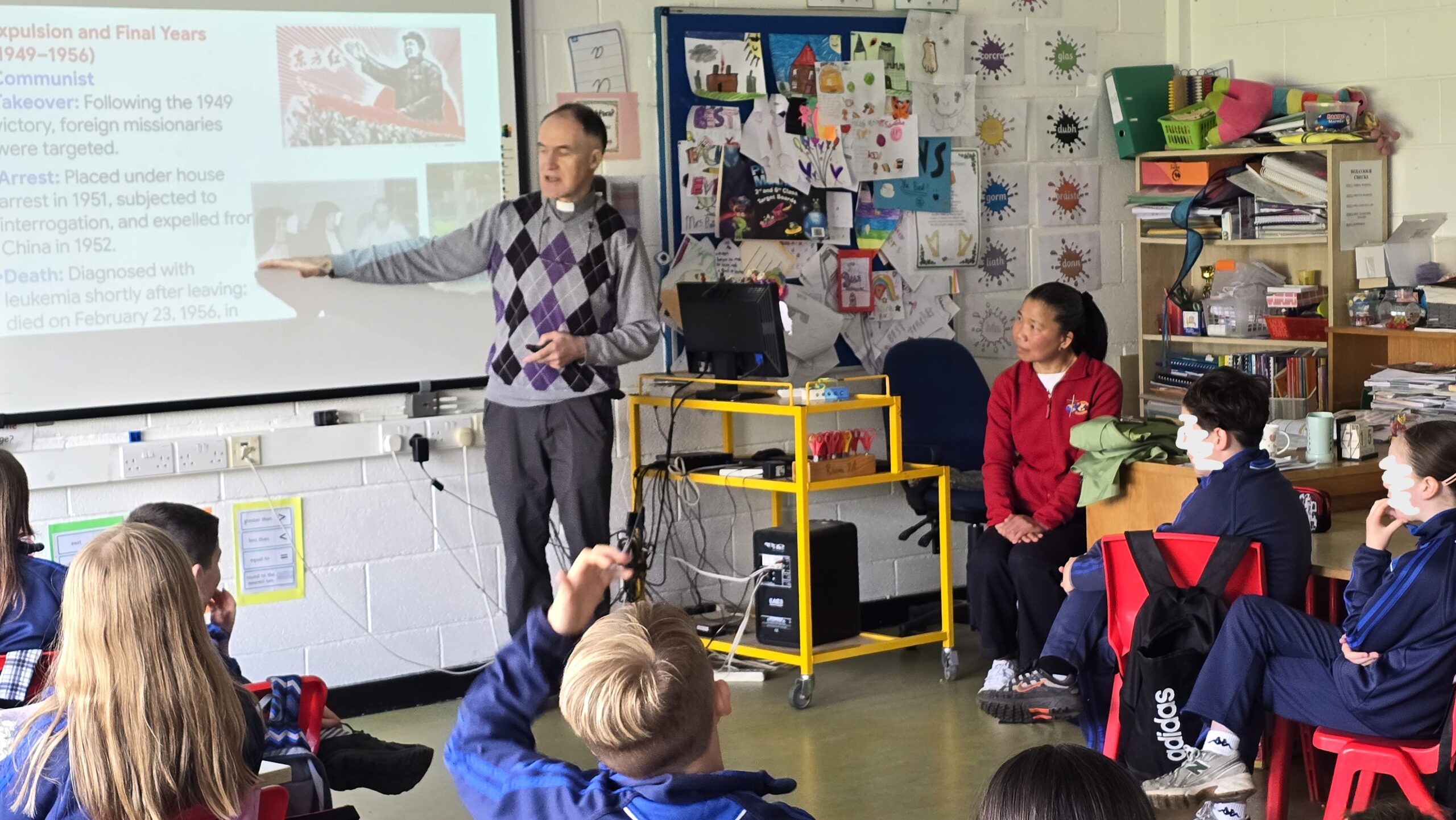
Columban Missionaries Fr Pat Colgan and Angie Escarsa were invited to visit Bishop Galvin National School in Templeogue, Dublin which is named after Bishop Edward Galvin, co-founder of the Missionary Society of St Columban.
They spoke to 3rd and 4th classes about Bishop Galvin’s life, his time in China, and his legacy through the Columban Missionaries.
Bishop Galvin National School first opened its doors on the 1st July 1975. The school was founded during a time of rapid population growth in this part of Dublin.
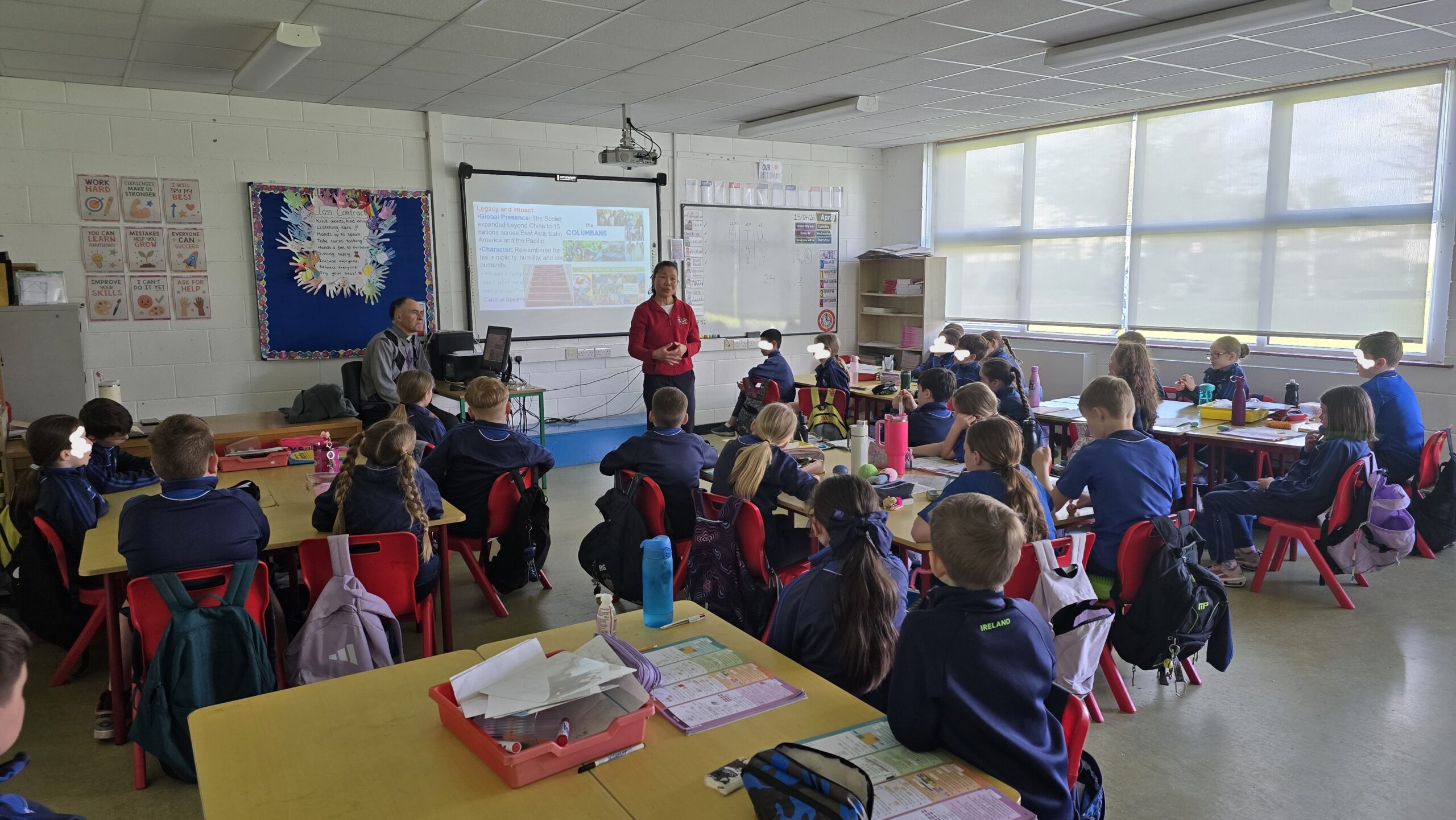
Columban Lay Missionary Angie Escarsa speaking to pupils at Bishop Galvin NS. Photo: Sarah Mac Donald
It was established on five acres of land donated by the Columban Fathers to St Jude the Apostle Parish, Willington — a remarkable gift then valued at IR£140,000.
The school was designed to serve 600 pupils, and by the late 1970s, enrolment made that a reality.
In 1979, Bishop Shanahan NS opened beside Bishop Galvin NS, and the two schools have shared a cooperative and creative relationship ever since. Bishop Shanahan NS and Bishop Galvin NS were the first co-educational schools in the area.
Bishop Joseph Shanahan was a Spiritan missionary bishop who pioneered education in Nigeria and founded the congregation of the Missionary Sisters of the Holy Rosary, based in Killashandra, Co Cavan, in 1924.
The crest for Bishop Galvin National School in Templeogue, designed by former Deputy Principal Richard Delaney, is a rich symbol of the school's mission, history, and the life of Bishop Galvin.

Logo of Bishop Galvin NS
It features a central dragon representing China and Bishop Galvin's missionary work, a staff symbolising authority, and a flame representing the pursuit of knowledge.
- The Dragon: Symbolises China, representing Bishop Galvin's missionary work in the Far East.
- The Staff: Held by the dragon, it represents the Bishop's authority.
- The Flame: Rising from the staff, it represents the flame of knowledge and the pursuit of education.
- The Rising Sun: Positioned behind the dragon, it evokes "The Far East".
The crest embodies the school's commitment to nurturing talents, fostering positive relationships, and providing a strong, supportive education
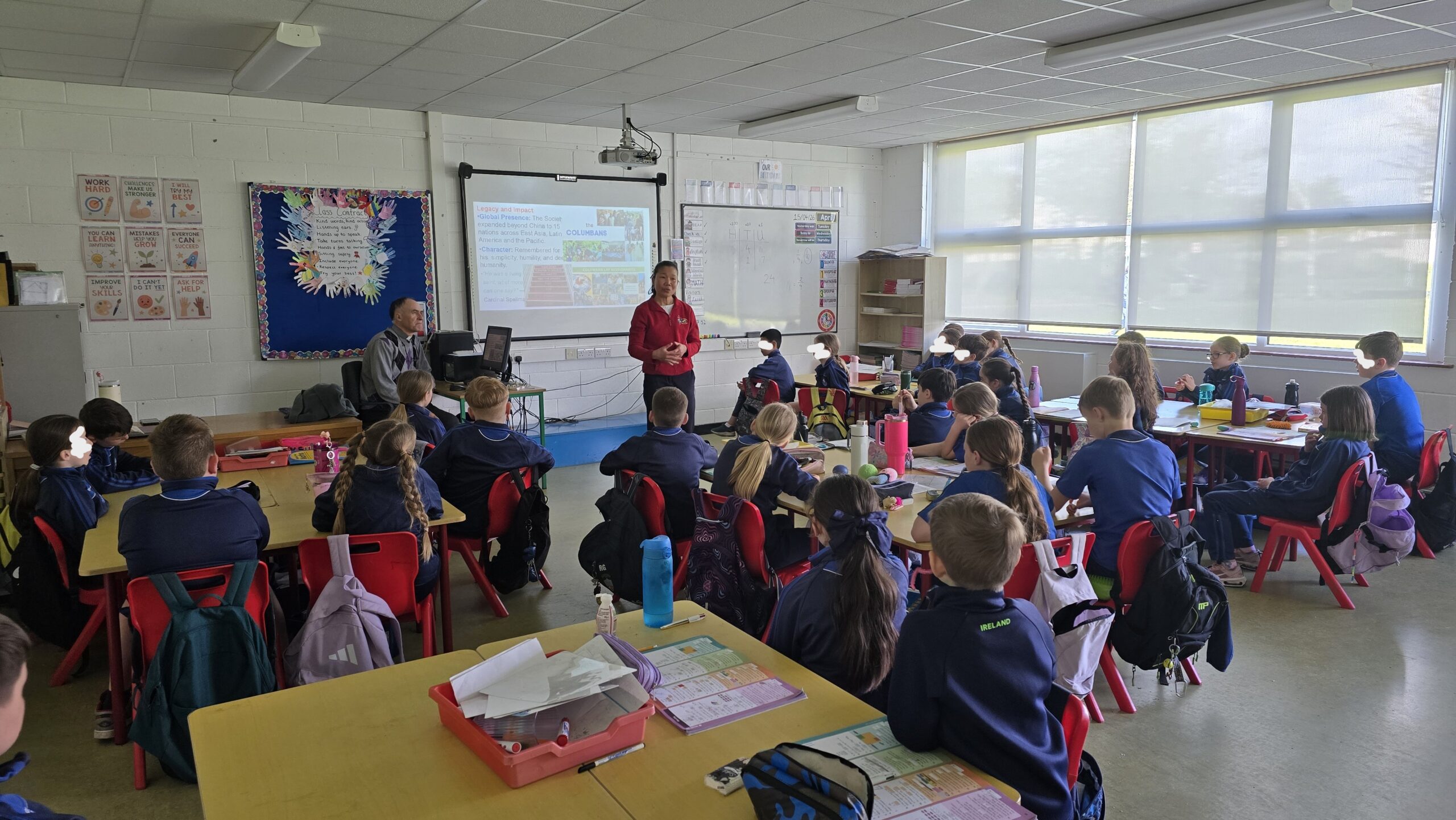
Columban Missionaries Fr Pat Colgan and Angie Escarsa speaking at Bishop Galvin NS. Photo: Sarah Mac Donald
The Columbans would like to thank Bishop Galvin National School, the Principal, Kathryn Corbett, and her staff, for their warm welcome. It was a wonderful day!
Another school named after our Columban co-founder is Bishop Galvin Central School in Newcestown, Co Cork, the birthplace of Edward Galvin.
The school's website has this information about the Columban missionary they are named after:

Two years later, Fr Galvin led the first pioneer band of missionaries to China. They encountered many problems such as poverty, hunger, leprosy and TB. From 1921-1950, China was in constant chaos.
In 1927, he was ordained as Bishop of Hangyang. In 1931, 200,000 victims of flooding depended largely on the Hangyang missions for food and aid. In 1937, at the outbreak of war between China and Japan, the Columbans were called upon to care for wounded Chinese soldiers.
During World War II, American and Australian Columbans were considered enemies and forced to return home. Bishop Galvin was expelled from China in 1952 and left for the US before returning to Ireland where he died in late 1957.
Bishop Galvin answered God’s call and throughout his life gave of himself to others and offered 40 heroic years to missionary service in helping others less fortunate than himself."